
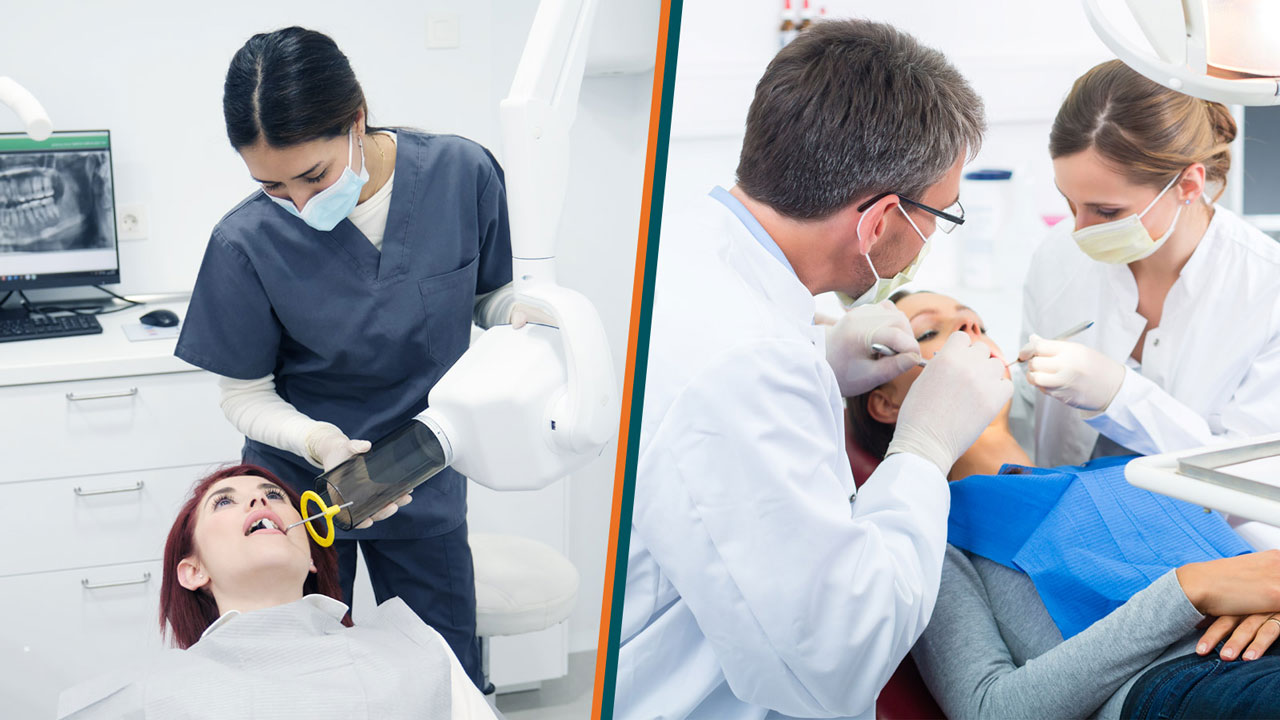
If you enjoy being a dental assistant but want to work more closely with patients, you might consider becoming a dental hygienist. These professionals work alongside dentists to assess patients and provide care.
With your background in the dental field, you can make the transition from dental assistant to dental hygienist in just a few steps. While every professional journey is different, this guide will show you a general outline on how to advance into a hygiene role.
What’s the Difference Between a Dental Assistant vs. a Dental Hygienist?
Dental assistants and dental hygienists might have similar job titles and some overlapping responsibilities, but they serve different functions in dental clinics. Hygienists usually spend more time delivering patient care, while assistants split their time between helping dentists and handling administrative work.
There are also different educational requirements for the two roles. Dental assistants usually only need a certificate or diploma to start working. Dental hygienists need at least an associate degree, though some employers prefer hygienists to have their bachelor’s.
It’s common to begin your career as a dental assistant and gain experience before transitioning into a role as a hygienist. WCU graduate Julie Rehder worked as a dental assistant for almost five years before she went back to school to earn a bachelor’s degree in dental hygiene.
“The dentist I worked for was encouraging me to pursue my degree and after my best friend graduated from the same program at West Coast…it drove it home that I could do it,” she said.
If you’re interested in doing the same, it’s worth knowing the biggest differences between dental assistants and dental hygienists.
Dental Assistant Responsibilities
As a dental assistant, you know the drill — literally. These professionals offer support to dentists and dental hygienists, and they also handle many administrative tasks. Their responsibilities can include (but aren’t limited to) the following:
- Prepare and clean treatment rooms
- Make patients feel comfortable
- Pass tools to dentists
- Maintain patient records
- Schedule appointments
- Manage billing processes
Dental Hygienist Responsibilities
Dental hygienists usually have more responsibilities than assistants. They can provide direct patient care with minimal or no supervision. Hygienists also work closely with dentists to prepare treatment plans.
A dental hygienist’s job duties may include these tasks, among others:
- Perform teeth cleanings and remove tartar and plaque buildup
- Assess patients for potential problems, like gum disease
- Position patients for X-rays and take pictures of teeth
- Consult with dentists to determine treatment plans
- Advise patients on healthy oral hygiene practices, like flossing
While many dental hygienists work in clinical care, some choose to take different paths. According to the American Dental Hygienists’ Association (ADHA), some other potential areas where hygienists can work include:
- Public health
- Education
- Corporate
- Research and innovation
- Administration
- Entrepreneurship
Earning a Bachelor of Science in Dental Hygiene (BSDH) can open doors to these different pathways.
How to Become a Dental Hygienist From a Dental Assistant
Even with your experience as a dental assistant, you need to take a few extra steps before you can transition fully into a hygienist role. These include earning a degree, passing exams, and becoming licensed to practice.
Here’s how you can prepare for the next step in your dental career:
1. Complete a Dental Hygiene Program
Start by researching the dental hygiene program you want to attend. Decide whether you plan to earn an associate or bachelor’s degree. Look for schools with an accredited dental hygiene program.
Once you’ve picked a school, complete an application and meet other requirements for admission. During the application process, highlight your dental assisting experience and career goals to show why you’d make a great fit for the dental hygiene program.
While in school, you will take a variety of classes, such as anatomy, oral pathology, dental radiology, and periodontology. Your program will also include hands-on clinical training, so you can get experience working with patients.
2. Pass the NBDHE
After graduating from a dental hygiene program, you can sign up to take the National Board Dental Hygiene Examination (NBDHE). This national exam has 350 multiple-choice questions designed to test your knowledge of core dental hygiene areas, including:
- Scientific principles
- Clinical dental hygiene services
- Community health and research
- Patient care
You should get your test results about three to four weeks after the exam.
3. Meet State Requirements for Licensure
All states require dental hygienists to have a professional license, but specific requirements vary. In California, you must pass a law and ethics examination to earn your license. If you didn’t graduate from a California accredited program, you will also need to take a board-approved clinical exam.
4. Apply for Jobs
Once you’ve earned your degree and license, you can start applying for dental hygienist jobs. Update your resume to reflect your new education and clinical training. Highlight the transferable skills you learned from your previous experience as a dental assistant, such as patient communication and compassion.
As you search for jobs, lean on your existing network. Ask around to see if anyone at your former practice knows about potential openings. According to research, nearly half of all new jobs get filled through networking. Use your connections as a former dental assistant to your advantage!
How Long Does It Take to Become a Dental Hygienist?
It takes between 2 and 4 years to become a dental hygienist, depending on whether you earn an associate or bachelor’s degree in dental hygiene.
If you want to continue working while going to school, speak with your current employer before enrolling. Many dental hygiene programs are full time, so you may need some scheduling flexibility to balance both commitments.
Advance Your Education With A Dental Hygiene Degree From WCU
With the right education, training, and preparation, you can make the move from dental assistant to dental hygienist. While the transition requires time and commitment, it can be well worth the investment if you want to work more closely with patients and expand your career options.
At West Coast University, we can help you prepare to make the move with our Dental Hygiene program. Our comprehensive curriculum, on-campus clinical training, and access to industry-current equipment will give you the opportunity to advance in your dental career.
You can complete the program and earn your dental hygiene degree in as little as 34 months. Want to learn more? Schedule an information session today!
WCU provides career guidance and assistance but cannot guarantee employment. The views and opinions expressed are those of the individuals and do not necessarily reflect the beliefs or position of the school or of any instructor or student.


 Call
Call Info Session