
News
Undergraduate


10-week terms allow for start dates throughout the year
Earn your BSN in as few as 39 months at the Accelerated program pace
Complete 120 credits to earn your BSN degree


Hands-on practice in technologically advanced simulation labs that use high-fidelity manikins that cry, sweat, and respond like real patients

A Clinical Placements team that helps you find and select a local preceptor and clinical site that aligns with your goals

One-on-one NCLEX support and extensive resources to help you prepare for your registered nurse (RN) licensure exam

Access to a Student Success advisor, no-cost tutoring, a Career Services team that helps you beyond graduation, and more
With the Los Angeles healthcare market being vast and varied with more than 10 million people within its limits,1 there is a substantial need for healthcare professionals within this region. If you’re looking to positively impact people’s lives as a registered nurse and you reside in or near the greater L.A. area, you may be interested in the Bachelor of Science in Nursing (BSN) program at West Coast University’s Los Angeles campus.
Our BSN program at WCU-Los Angeles combines classroom learning with hands-on practice to help prepare you for fast-paced and often unpredictable world of nursing. In this program, you will learn the foundations of evidence-based patient care, as well as how to care for patients in specific healthcare environments and specialty areas (e.g., medical surgical nursing, pediatric nursing, public health nursing, etc.).
Upon completing the program, you will be eligible to sit for the National Council Licensure Examination for registered nurses (NCLEX-RN).
Our Bachelor of Science in Nursing program at WCU-LA comes with the benefit of speed to completion, which is helpful when you’re eager to get started on your future career as a registered nurse.
On-Campus
120 Credits
39 Months
8 Semesters
This curriculum applies to students matriculating or reentering after December 1, 2022.
All science courses must have been taken within the last five calendar years, unless the student possesses a degree or advanced degree in the specific field of study for which the student is seeking transfer credit. Additional information regarding transfer credit is located in the university’s catalog under Transfer Credit policy or below.
| Category and Requirements | WCU Course Requirements | Transferable / Options |
|---|---|---|
| Foundational Course | FYS 001 (0): First Year Seminar (only offered at Los Angeles and Ontario prior to Spring II 2024)
FHE 100 (3): Foundations of Higher Education (offered at all Campuses; Los Angeles and Ontario Campuses starting Spring II 2024) |
Non-transferable |
| A. Written Communication (6 Semester Credits) | * ENGL 140 (3): Written Communication I * ENGL 240 (3): Written Communication II |
Equivalent to ENGL 140 Equivalent to ENGL 240 |
| B. Oral and Interpersonal Communications (3 Semester Credits) |
*SPCH 142(3): Oral Communication | Equivalent to SPCH 142 |
| C. Critical Thinking and Ethical Reasoning (3 Semester Credits) |
*PHIL 341(3): Critical Reasoning | Equivalent to PHIL 341 |
| D. Quantitative Literacy (6 Semester Credits) |
MATH 108(3): College Mathematics I MATH 211(3): Statistics |
Equivalent to MATH 108
Equivalent to MATH 211 |
| E. Social and Behavioral Sciences Awareness (6 Semester Credits) |
*PSYC 160(3): Psychology *PSYC 290(3): Life Span Psychology |
Equivalent to PSYC 160 Equivalent to PSYC 290 |
| F. Historical, Cultural, and Aesthetic Recognition (3 Semester Credits) |
* HUM 370 (3): Cultural Pluralism | Equivalent to HUM 370 |
| G. Scientific Reasoning (16 Semester Credits) |
|
|
| General Education Capstone (3 Semester Credits) |
CAPS 401(3): General Education Capstone (only offered at Los Angeles, Ontario Campuses prior to Spring II 2024) |
Non-transferable |
| A minimum of 46 credits is required for graduation. | ||
| General Education within the Area of Study | ||
| PATH 370 | Pathophysiology | 3 |
| PHIL 434 | Medical Ethics and Issues | 3 |
| Total Credit Hours: | 6 | |
| Core Nursing Courses | ||
| NURS 100 | Fundamentals of Nursing | 3 |
| NURS 101L | Fundamentals of Nursing Skills Lab | 2 |
| NURS 110 | Introduction to Professional Nursing | 2 |
| NURS 120 | Introduction to Medical Surgical Nursing | 3 |
| NURS 121L-A | Introduction to Medical Surgical Nursing Practicum | 2 |
| NURS 121L-B | Introduction to Medical Surgical Nursing Practicum – On-Campus | 1 |
| NURS 180 | Pharmacology | 3 |
| NURS 190 | Physical Assessment | 2 |
| NURS 201 | Medical Surgical Nursing-Promoting Wellness | 3 |
| NURS 211L | Medical Surgical Nursing | 3 |
| NURS 222 | Mental Health/Psychiatric Nursing: Promoting Wellness in the Mentally Ill | 3 |
| NURS 223L | Mental Health/Psychiatric Nursing: Promoting Wellness Practicum | 2 |
| NURS 225 | Nutrition in Health and Disease | 3 |
| NURS 306 | Expanding Family and Community (OB) | 2 |
| NURS 307 | Developing Family and Community (PEDS) | 2 |
| NURS 316L-A | Expanding and Developing Family and Community Practicum (OB) | 1.5 |
| NURS 317L-A | Developing Family and Community Practicum (PEDS) | 1.5 |
| NURS 340 | Public Health Nursing | 3 |
| NURS 342L | Public Health Nursing Practicum | 2 |
| NURS 350 | Research in Nursing | 3 |
| NURS 420 | Principles of Leadership and Management | 3 |
| NURS 431 | Disaster Management | 2 |
| NURS 440 | Issues and Trends in Nursing | 3 |
| NURS 480 | Advanced Medical Surgical Nursing: Promoting Wellness Practicum | 3 |
| NURS 481L | Advanced Medical Surgical Nursing: Promoting Wellness Practicum | 3 |
| NURS 493* | Integration of Nursing Concepts | 3 |
| NURS 497 | Nursing Capstone | 1 |
| NURS 498L | Integration of Nursing Practices | 3 |
| Total Credit Hours: | 68.0 | |
| Program Credit Distribution | ||
| General Education Semester Credits | 46.0 | |
| General Education within the Area of Study | 6.0 | |
| Core Nursing Courses | 68.0 | |
| Total Program Semester Credits | 120.0 | |
We know school is a substantial commitment. At WCU, we want to equip you with all the information you need to make the right decision for your future.
Our goal is to give you a clear understanding of Los Angeles Bachelor of Science in Nursing tuition costs so you can be well-informed as you navigate the application and enrollment process. To assist you in your decision, we provide a breakdown below of the Bachelor of Science in Nursing program costs in Los Angeles at West Coast University.
We offer several financial aid options — including scholarships, grants, and loan access — to help support you through your studies. For more information about your financial support options, visit our Financial Aid page.
We offer several financial aid options — including scholarships, grants, and loan access — to help support your studies and make the program as affordable as possible. For more information about your financial support options, visit our financial aid page.
Estimated Cost of Attendance is comprised of both direct costs and indirect costs, as outlined in the charts below. The purpose of the Cost of Attendance (COA) is to provide students and families with an estimated cost to attend West Coast University. The COA includes both direct and indirect cost estimates and are categorized as follows: (1) Direct costs are paid directly to West Coast University and are shown separately for each program; (2) Indirect costs are not paid to West Coast University and are estimates students may use to budget expenses they may incur while attending school. While actual indirect costs may vary, West Coast University estimates these amounts based on the number of months in an academic year and whether students will live with parents or off campus.
Direct Costs
| Degree Type | Start Date prior to Fall II 2024 | Start Date on and after Fall II 2024 |
| Total Program Credits | 120 | 120 |
| Program Length(Full-Time) | 8 semesters | 8 semesters |
| Full-Time Status(12 to 18 credits) | $18,250 | $15,000 |
| 3/4-Time Status(9 to 11 credits) | $15,212 | $12,450 |
| 1/2-Time Status(6 to 8 credits) | $11,810 | $9,750 |
| Less than 1/2-Time Status(under 6 credits) (per credit) | $2,026 | $1,665 |
| Total Tuition Costs(Full-Time) | $146,000 | $120,000 |
| Registration Fee(refundable) | $75 | $75 |
| STRF Fee1(non-refundable) | $0 | $0 |
| Estimated Total Book Costs2 | $4,214 | $4,214 |
| Estimated Total Book Shipping Cost2 | $421 | $421 |
| Estimate for Uniforms Fees2 | $250 | $250 |
| Estimate for Supplies &Licensure Preparation Fees2 | $4,200 | $4,200 |
| Technology Fee3($100 per semester) | $800 | $800 |
| General Education Resource Fee4 | $500 | $500 |
| Core Nursing Fee5 | $26,000 | |
| Estimated Total Program Costs | $156,460 | $156,460 |
Indirect Costs:
| 10 Month Academic Year | ||||
| Prior to Fall 1 2026 | Starting Fall I 2026 | |||
| with parents | off campus | with parents | off campus | |
| Federal Student Loan Fees | $100 | $100 | $100 | $100 |
| Course Materials (Personal Electronic Device-1st year only) | $1,000 | $1,000 | $1,000 | $1,000 |
| Living Expenses (Food & Housing) | $3,270 | $10,910 | $3,630 | $11,340 |
| Transportation | $2,200 | $2,200 | $2,400 | $2,400 |
| Miscellaneous Personal Expenses | $7,070 | $7,070 | $8,060 | $8,060 |
| Total | $13,660 | $21,300 | $15,190 | $22,900 |
1 Effective April 1, 2024, the Student Tuition Recovery Fund (STRF) assessment rate will be zero dollars and zero cents ($0.00) per one thousand dollars ($1,000) of institutional charges.
The State of California established the Student Tuition Recovery Fund (STRF) to relieve or mitigate economic loss suffered by a student in an educational program at a qualifying institution, who is or was a California resident while enrolled, or was enrolled in a residency program, if the student enrolled in the institution, prepaid tuition, and suffered an economic loss. Unless relieved of the obligation to do so, you must pay the state-imposed assessment for the STRF, or it must be paid on your behalf, if you are a student in an educational program, who is a California resident, or are enrolled in a residency program, and prepay all or part of your tuition.
You are not eligible for protection from the STRF and you are not required to pay the STRF assessment, if you are not a California resident, or are not enrolled in a residency program.
It is important that you keep copies of your enrollment agreement, financial aid documents, receipts, or any other information that documents the amount paid to the school. Questions regarding the STRF may be directed to the Bureau for Private Postsecondary Education, 1747 N. Market Blvd. Ste 225 Sacramento, CA 95834, (916) 431-6959 or (888) 370-7589.
To be eligible for STRF, you must be a California resident or enrolled in a residency program, prepaid tuition, paid or deemed to have paid the STRF assessment, and suffered an economic loss as a result of any of the following:
To qualify for STRF reimbursement, the application must be received within four (4) years from the date of the action or event that made the student eligible for recovery from STRF.
A student whose loan is revived by a loan holder or debt collector after a period of noncollection may, at any time, file a written application for recovery from STRF for the debt that would have otherwise been eligible for recovery. If it has been more than four (4) years since the action or event that made the student eligible, the student must have filed a written application for recovery within the original four (4) year period, unless the period has been extended by another act of law.
However, no claim can be paid to any student without a social security number or a taxpayer identification number.
2 The Estimate for Book, Uniform, and Supply fees reflect the Manufacturer’s Suggested Retail Price totals compiled in December 2024 and are subject to change. Supplies become student purchases once issued to student. Students who drop or have been dismissed after supplies have been issued will assume ownership for these items and will not be eligible for refunds. For details on all of the supplies, contact the Student Accounts Office.
BSN | Supplies issued in NURS 101L Fundamentals of Nursing Skills Lab.
3 Technology Fee includes student technical support, Office 365, blended and online course delivery/learning management system, mobile app, student portal technology and access, and required electronic course materials/software.
4 The General Education Resource Fee includes costs associated with lab supplies and materials, Labster virtual labs and simulations, and Tutor.com access.
5 The Core Nursing Fee will be billed each semester in which Core Nursing courses are scheduled and covers costs associated with background checks and drug screenings; the operation of equipment for Simulation, Technology, including but not limited to the establishment, scheduling, coordination, site visits, on-going management, and other expenses related to clinical activities. 5 Core Nursing Semesters multiplied by $5,408 per Core Nursing Semester effective Fall I 2025 and $5,200 per Core Nursing Semester prior to Fall I 2025.
Note 1: Students who wish to take Challenge Exams will be subject to a fee of $100 for each Challenge exam. Please see the campus Student Accounts Office for a full price listing.
Note 2: Course Audit Policy – Students auditing a course are not charged tuition or fees for the audited course. However, if a student enrolls in both an audit course and a credit-bearing course in the same semester/trimester, they will be responsible for the tuition and applicable fees associated with the credit-bearing course.
Note 3: The Total Tuition Cost can be converted to Cost per Credit Hour by using the following calculation:
If enrolled prior to Fall II 2024, Total Tuition Cost (Prior to Fall I 2025) ($146,000) divided by the Total Program Credits (120) = Cost Per Credit Hour ($1,216.67).
If enrolled after Fall II 2024, Total Tuition Cost (Prior to Fall I 2025) ($120,000) divided by the Total Program Credits (120) = Cost Per Credit Hour ($1,000.00).
If enrolled prior to Fall II 2024, Total Tuition Cost (Starting Fall I 2025) ($151,840) divided by the Total Program Credits (120) = Cost Per Credit Hour ($1,265.33).
If enrolled after Fall II 2024, Total Tuition Cost (Starting Fall I 2025) ($124,800) divided by the Total Program Credits (120) = Cost Per Credit Hour ($1,040.00).
Note 4: Students who are required by the Program Dean to repeat a course to maintain program-related skills and knowledge will not be assessed tuition for that course. Other institutional fees may be waived only if the student is not enrolled in any additional courses during the same semester. Course sections designated with “RE” indicate courses taken for skill and knowledge maintenance under this policy. Number of repeat attempts can be found on the University Dismissal Catalog page.
Direct Costs
| Degree Type | Start Date prior to Fall II 2024 | Start Date on and after Fall II 2024 |
| Total Program Credits | 120 | 120 |
| Program Length(Full-Time) | 8 semesters | 8 semesters |
| Full-Time Status(12 to 18 credits) | $18,980 | $15,600 |
| 3/4-Time Status(9 to 11 credits) | $15,820 | $12,950 |
| 1/2-Time Status(6 to 8 credits) | $12,282 | $10,140 |
| Less than 1/2-Time Status(under 6 credits) (per credit) | $2,107 | $1,732 |
| Total Tuition Costs(Full-Time) | $151,840 | $124,800 |
| Registration Fee(refundable) | $75 | $75 |
| STRF Fee1(non-refundable) | $0 | $0 |
| Estimated Total Book Costs2 | $4,006 | $4,006 |
| Estimated Total Book Shipping Cost2 | $401 | $401 |
| Estimate for Uniforms Fees2 | $250 | $250 |
| Estimate for Supplies &Licensure Preparation Fees2 | $4,200 | $4,200 |
| Technology Fee3($100 per semester) | $800 | $800 |
| General Education Resource Fee4 | $500 | $500 |
| Core Nursing Fee5 | $27,040 | |
| Estimated Total Program Costs | $162,072 | $162,072 |
Indirect Costs:
| 10 Month Academic Year | ||||
| Prior to Fall 1 2026 | Starting Fall I 2026 | |||
| with parents | off campus | with parents | off campus | |
| Federal Student Loan Fees | $100 | $100 | $100 | $100 |
| Course Materials (Personal Electronic Device-1st year only) | $1,000 | $1,000 | $1,000 | $1,000 |
| Living Expenses (Food & Housing) | $3,270 | $10,910 | $3,630 | $11,340 |
| Transportation | $2,200 | $2,200 | $2,400 | $2,400 |
| Miscellaneous Personal Expenses | $7,070 | $7,070 | $8,060 | $8,060 |
| Total | $13,660 | $21,300 | $15,190 | $22,900 |
1 Effective April 1, 2024, the Student Tuition Recovery Fund (STRF) assessment rate will be zero dollars and zero cents ($0.00) per one thousand dollars ($1,000) of institutional charges.
The State of California established the Student Tuition Recovery Fund (STRF) to relieve or mitigate economic loss suffered by a student in an educational program at a qualifying institution, who is or was a California resident while enrolled, or was enrolled in a residency program, if the student enrolled in the institution, prepaid tuition, and suffered an economic loss. Unless relieved of the obligation to do so, you must pay the state-imposed assessment for the STRF, or it must be paid on your behalf, if you are a student in an educational program, who is a California resident, or are enrolled in a residency program, and prepay all or part of your tuition.
You are not eligible for protection from the STRF and you are not required to pay the STRF assessment, if you are not a California resident, or are not enrolled in a residency program.
It is important that you keep copies of your enrollment agreement, financial aid documents, receipts, or any other information that documents the amount paid to the school. Questions regarding the STRF may be directed to the Bureau for Private Postsecondary Education, 1747 N. Market Blvd. Ste 225 Sacramento, CA 95834, (916) 431-6959 or (888) 370-7589.
To be eligible for STRF, you must be a California resident or enrolled in a residency program, prepaid tuition, paid or deemed to have paid the STRF assessment, and suffered an economic loss as a result of any of the following:
To qualify for STRF reimbursement, the application must be received within four (4) years from the date of the action or event that made the student eligible for recovery from STRF.
A student whose loan is revived by a loan holder or debt collector after a period of noncollection may, at any time, file a written application for recovery from STRF for the debt that would have otherwise been eligible for recovery. If it has been more than four (4) years since the action or event that made the student eligible, the student must have filed a written application for recovery within the original four (4) year period, unless the period has been extended by another act of law.
However, no claim can be paid to any student without a social security number or a taxpayer identification number.
2 The Estimate for Book, Uniform, and Supply fees reflect the Manufacturer’s Suggested Retail Price totals compiled in December 2024 and are subject to change. Supplies become student purchases once issued to student. Students who drop or have been dismissed after supplies have been issued will assume ownership for these items and will not be eligible for refunds. For details on all of the supplies, contact the Student Accounts Office.
BSN | Supplies issued in NURS 101L Fundamentals of Nursing Skills Lab.
3 Technology Fee includes student technical support, Office 365, blended and online course delivery/learning management system, mobile app, student portal technology and access, and required electronic course materials/software.
4 The General Education Resource Fee includes costs associated with lab supplies and materials, Labster virtual labs and simulations, and Tutor.com access.
5 The Core Nursing Fee will be billed each semester in which Core Nursing courses are scheduled and covers costs associated with background checks and drug screenings; the operation of equipment for Simulation, Technology, including but not limited to the establishment, scheduling, coordination, site visits, on-going management, and other expenses related to clinical activities. 5 Core Nursing Semesters multiplied by $5,408 per Core Nursing Semester effective Fall I 2025 and $5,200 per Core Nursing Semester prior to Fall I 2025.
Note 1: Students who wish to take Challenge Exams will be subject to a fee of $100 for each Challenge exam. Please see the campus Student Accounts Office for a full price listing.
Note 2: Course Audit Policy – Students auditing a course are not charged tuition or fees for the audited course. However, if a student enrolls in both an audit course and a credit-bearing course in the same semester/trimester, they will be responsible for the tuition and applicable fees associated with the credit-bearing course.
Note 3: The Total Tuition Cost can be converted to Cost per Credit Hour by using the following calculation:
If enrolled prior to Fall II 2024, Total Tuition Cost (Prior to Fall I 2025) ($146,000) divided by the Total Program Credits (120) = Cost Per Credit Hour ($1,216.67).
If enrolled after Fall II 2024, Total Tuition Cost (Prior to Fall I 2025) ($120,000) divided by the Total Program Credits (120) = Cost Per Credit Hour ($1,000.00).
If enrolled prior to Fall II 2024, Total Tuition Cost (Starting Fall I 2025) ($151,840) divided by the Total Program Credits (120) = Cost Per Credit Hour ($1,265.33).
If enrolled after Fall II 2024, Total Tuition Cost (Starting Fall I 2025) ($124,800) divided by the Total Program Credits (120) = Cost Per Credit Hour ($1,040.00).
Note 4: Students who are required by the Program Dean to repeat a course to maintain program-related skills and knowledge will not be assessed tuition for that course. Other institutional fees may be waived only if the student is not enrolled in any additional courses during the same semester. Course sections designated with “RE” indicate courses taken for skill and knowledge maintenance under this policy. Number of repeat attempts can be found on the University Dismissal Catalog page.
Direct Costs
| Degree Type | Start Date prior to Fall II 2024 | Start Date on and after Fall II 2024 |
| Total Program Credits | 120 | 120 |
| Program Length(Full-Time) | 8 semesters | 8 semesters |
| Full-Time Status(12 to 18 credits) | $19,739 | $16,224 |
| 3/4-Time Status(9 to 11 credits) | $16,453 | $13,466 |
| 1/2-Time Status(6 to 8 credits) | $12,773 | $10,546 |
| Less than 1/2-Time Status(under 6 credits) (per credit) | $2,191 | $1,801 |
| Total Tuition Costs(Full-Time) | $157,912 | $129,792 |
| Registration Fee(refundable) | $75 | $75 |
| STRF Fee1(non-refundable) | $0 | $0 |
| Estimated Total Book Costs2 | $3,810 | $3,810 |
| Estimated Total Book Shipping Cost2 | $381 | $381 |
| Estimate for Uniforms Fees2 | $250 | $250 |
| Estimate for Supplies &Licensure Preparation Fees2 | $4,200 | $4,200 |
| Technology Fee3($100 per semester) | $800 | $800 |
| General Education Resource Fee4 | $500 | $500 |
| Core Nursing Fee5 | $28,120 | |
| Estimated Total Program Costs | $167,928 | $167,928 |
Indirect Costs:
| 10 Month Academic Year | ||||
| Prior to Fall 1 2026 | Starting Fall I 2026 | |||
| with parents | off campus | with parents | off campus | |
| Federal Student Loan Fees | $100 | $100 | $100 | $100 |
| Course Materials (Personal Electronic Device-1st year only) | $1,000 | $1,000 | $1,000 | $1,000 |
| Living Expenses (Food & Housing) | $3,270 | $10,910 | $3,630 | $11,340 |
| Transportation | $2,160 | $2,160 | $2,400 | $2,400 |
| Miscellaneous Personal Expenses | $7,070 | $7,070 | $8,060 | $8,060 |
| Total | $13,660 | $20,740 | $15,190 | $22,900 |
1 Effective April 1, 2024, the Student Tuition Recovery Fund (STRF) assessment rate will be zero dollars and zero cents ($0.00) per one thousand dollars ($1,000) of institutional charges.
The State of California established the Student Tuition Recovery Fund (STRF) to relieve or mitigate economic loss suffered by a student in an educational program at a qualifying institution, who is or was a California resident while enrolled, or was enrolled in a residency program, if the student enrolled in the institution, prepaid tuition, and suffered an economic loss. Unless relieved of the obligation to do so, you must pay the state-imposed assessment for the STRF, or it must be paid on your behalf, if you are a student in an educational program, who is a California resident, or are enrolled in a residency program, and prepay all or part of your tuition.
You are not eligible for protection from the STRF and you are not required to pay the STRF assessment, if you are not a California resident, or are not enrolled in a residency program.
It is important that you keep copies of your enrollment agreement, financial aid documents, receipts, or any other information that documents the amount paid to the school. Questions regarding the STRF may be directed to the Bureau for Private Postsecondary Education, 1747 N. Market Blvd. Ste 225 Sacramento, CA 95834, (916) 431-6959 or (888) 370-7589.
To be eligible for STRF, you must be a California resident or enrolled in a residency program, prepaid tuition, paid or deemed to have paid the STRF assessment, and suffered an economic loss as a result of any of the following:
To qualify for STRF reimbursement, the application must be received within four (4) years from the date of the action or event that made the student eligible for recovery from STRF.
A student whose loan is revived by a loan holder or debt collector after a period of noncollection may, at any time, file a written application for recovery from STRF for the debt that would have otherwise been eligible for recovery. If it has been more than four (4) years since the action or event that made the student eligible, the student must have filed a written application for recovery within the original four (4) year period, unless the period has been extended by another act of law.
However, no claim can be paid to any student without a social security number or a taxpayer identification number.
2 The Estimate for Book, Uniform, and Supply fees reflect the Manufacturer’s Suggested Retail Price totals compiled in December 2024 and are subject to change. Supplies become student purchases once issued to student. Students who drop or have been dismissed after supplies have been issued will assume ownership for these items and will not be eligible for refunds. For details on all of the supplies, contact the Student Accounts Office.
BSN | Supplies issued in NURS 101L Fundamentals of Nursing Skills Lab.
3 Technology Fee includes student technical support, Office 365, blended and online course delivery/learning management system, mobile app, student portal technology and access, and required electronic course materials/software.
4 The General Education Resource Fee includes costs associated with lab supplies and materials, Labster virtual labs and simulations, and Tutor.com access.
5 The Core Nursing Fee will be billed each semester in which Core Nursing courses are scheduled and covers costs associated with background checks and drug screenings; the operation of equipment for Simulation, Technology, including but not limited to the establishment, scheduling, coordination, site visits, on-going management, and other expenses related to clinical activities. 5 Core Nursing Semesters multiplied by $5,408 per Core Nursing Semester effective Fall I 2025 and $5,200 per Core Nursing Semester prior to Fall I 2025.
Note 1: Students who wish to take Challenge Exams will be subject to a fee of $100 for each Challenge exam. Please see the campus Student Accounts Office for a full price listing.
Note 2: Course Audit Policy – Students auditing a course are not charged tuition or fees for the audited course. However, if a student enrolls in both an audit course and a credit-bearing course in the same semester/trimester, they will be responsible for the tuition and applicable fees associated with the credit-bearing course.
Note 3: The Total Tuition Cost can be converted to Cost per Credit Hour by using the following calculation:
If enrolled prior to Fall II 2024, Total Tuition Cost (Prior to Fall I 2025) ($146,000) divided by the Total Program Credits (120) = Cost Per Credit Hour ($1,216.67).
If enrolled after Fall II 2024, Total Tuition Cost (Prior to Fall I 2025) ($120,000) divided by the Total Program Credits (120) = Cost Per Credit Hour ($1,000.00).
If enrolled prior to Fall II 2024, Total Tuition Cost (Starting Fall I 2025) ($151,840) divided by the Total Program Credits (120) = Cost Per Credit Hour ($1,265.33).
If enrolled after Fall II 2024, Total Tuition Cost (Starting Fall I 2025) ($124,800) divided by the Total Program Credits (120) = Cost Per Credit Hour ($1,040.00).
Note 4: Students who are required by the Program Dean to repeat a course to maintain program-related skills and knowledge will not be assessed tuition for that course. Other institutional fees may be waived only if the student is not enrolled in any additional courses during the same semester. Course sections designated with “RE” indicate courses taken for skill and knowledge maintenance under this policy. Number of repeat attempts can be found on the University Dismissal Catalog page.
For Admissibility into the BSN & LVN-BSN Program, Applicants Must Meet the Following Requirements:
Pre-Licensure Nursing Requirements prior to clinical assignments (ADN, BSN & LPN to BSN):
To receive transfer credit for this program, previous General Education course must have achieve a grade of at least a “C”, and Core courses require a minimum grade of a “C+”. Approval on transfer credit is based on the program’s discretion.
BSN or LVN-BSN applicants requesting transfer credit evaluation must provide the applicable official transcripts by seven (7) calendar days before the start of the term. All general education, prerequisite, and core nursing coursework must have been taken at an appropriately accredited institution. For nursing credits to be considered for transfer credit, there can be only one year between the end of the last nursing course taken at a previous institution and the beginning of the first course at West Coast University. Exceptions may be considered. Science courses must be taken within the last five years to be accepted for transfer credit. Course syllabi for courses previously taken at another nursing program should be submitted for review to the campus dean for nursing. The maximum allowable transfer credits applied to the BSN program shall not exceed 52 credits of general education. See the Challenge Credit policy for additional information on receiving nursing credit for previously completed nursing courses. Authority for all final transfer credit decisions is given to the Program Dean/Chair.
Transfer credit will not be awarded based on unofficial transcripts, however, students may be scheduled for their first semester of courses based on unofficial transfer credit review . Financial packaging for the first semester will be estimated without transfer credit unless/until official transcripts are received and evaluated. If transfer credit is evaluated after the add/drop date of the first semester, it will be reflected in financial aid offers for the subsequent semester.
BSN & LVN-BSN Postsecondary Transcripts for Veterans
All applicants who are veterans or seeking transfer credits must submit all official applicable postsecondary transcripts by seven (7) calendar days before the start of the term regardless of applicable transfer credits for timely certification of the veterans request for benefits and receipt of funds. Please see the Veterans Educational Benefits policy in the Financial Policies and Information Section of the Catalog.
For additional information, visit our catalog.
New academic terms begin, on average, every 10 weeks. To get an idea of when each term starts and ends, view our Academic Calendar.
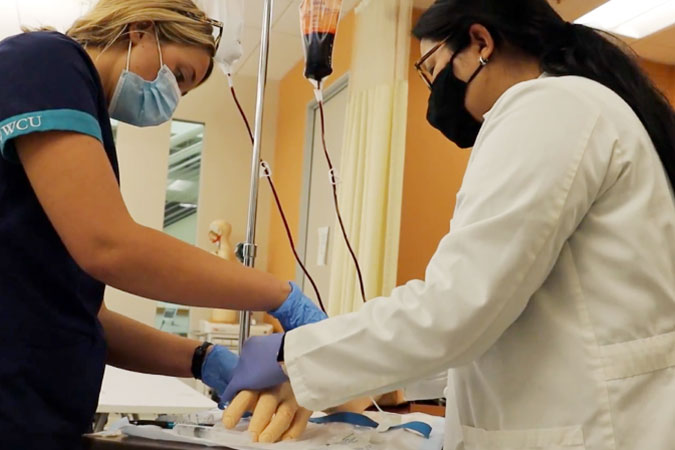
Our technologically advanced simulation labs at West Coast University are designed to put nursing students in simulated scenarios that mimic real life. Using realistic hospital-like settings and high-fidelity manikins that can cry, sweat, and respond just like real patients, students get to practice everything from taking vitals to assisting with births and surgeries.
These on-campus simulations give students hands-on practice in all types of care experiences, from routine checkups to emergency visits, so they can enter into real clinical settings with knowledge and confidence.
Our simulation centers provide practice in scenarios across various medical specialty areas and disciplines, including:

To help equip you for success in your clinical training experiences, we have a Clinical Placements team that can help you find the right practice site in your local area. We have a large network of hospital and clinical partners, which serves as a valuable resource to any student who needs to choose a preceptor and clinical location.
You will be assigned a coordinator of clinical relations, who will guide you through the process from initial selection to compliance tracking and general advice.
At WCU-Los Angeles, we provide a comprehensive BSN curriculum and various student resources to help prepare you for the National Council Licensure Examination (NCLEX).
Here’s what we make available to our students:
It’s our goal to help you walk into your exam with complete confidence so you can pass your test and get licensed as an RN right away!
Support for WCU students doesn’t end at graduation. As a WCU-LA graduate, you will have ongoing access to a wealth of resources from our Career Services team, including one-on-one guidance, professional development workshops, career fairs, connections with industry recruiters, and more.)2 Whether you need help fine-tuning your application materials, conducting mock interviews, or finding job leads that match your interests, we can help.
Our Career Services team can help you explore the job opportunities that are available to you. According to the U.S. Bureau of Labor Statistics, RNs often work in environments such as:
Upon graduation from West Coast University, students will have met the following program learning outcomes:
In the BSN program at WCU-LA, you can complete your degree in 39 months (8 semesters) at the Accelerated pace. As one of the accelerated BSN programs in Los Angeles, our program offers hands-on training in simulation labs and clinical placement support to help you gain real-world experience as you advance your education.
ABSN stands for Accelerated Bachelor of Science in Nursing. It is a fast-track nursing program designed for students who are interested in becoming licensed registered nurses, even if they already hold a non-nursing bachelor’s degree. ABSN programs typically require less credit hours than traditional BSN programs, and may not include general education courses.
WCU’s BSN program can be completed in as little as 39 months at the Accelerated pace. It requires 120 credits and includes general education courses — regardless of the pace you choose, which makes it different from an ABSN program. Learn more about if your previous coursework can be applied to your BSN education on our transfer credits page.
Yes, any previous bachelor’s degree that you obtained should not interfere with your ability to enroll in our Los Angeles BSN program. This program is designed for individuals who want to become licensed registered nurses.
The master’s degree you choose following completion of your BSN program depends on your professional goals. BSN graduates who are looking to work in a specialized area of nursing usually choose our Master of Nursing in Science program (or, if you’re already a licensed RN by the time you start your graduate program, our RN to MSN program). We have several specialty tracks available.
If you’re interested in focusing your education on community health, you may want to earn a Master of Public Health degree. We also offer Master of Health Administration and Master of Business Administration programs for students who want to advance into administrative roles.
An “RN” is a professional title that someone earns after passing the National Council Licensure Examination for registered nurses (NCLEX-RN). A BSN refers to a Bachelor of Science in Nursing, which is an academic degree that can help prepare a student for the NCLEX and a career as a registered nurse.
A BSN is not a requirement for licensure; however, it can be monumental in helping prepare aspiring RNs for the fast-paced and demanding job of nursing. It also helps lay the groundwork for future nursing specialization, which is typically achieved through a master’s degree.
Financial aid is available to those who are eligible. Students may qualify for financial aid options such as student loans, scholarships, grants, employer reimbursement, federal work-study, and more. Get additional information about institutional scholarships on the Undergraduate On-Ground Scholarships and Grants page of our online catalog. You can also get general financial aid information on our Financial Aid page.
West Coast University
12215 Victory Boulevard
North Hollywood, CA 91606
(818) 299-5500

The baccalaureate degree program in nursing, master’s degree program in nursing, Doctor of Nursing Practice program, and post-graduate APRN certificate program at West Coast University are accredited by the Commission on Collegiate Nursing Education 655 K Street, Suite 750, Washington DC 20001, (202) 877-6791 (www.ccneaccreditation.org).
Pursuing your degree is a big choice. Fill out our form and one of our admissions advisors will contact you to answer any questions you may have!
1 Bureau of Labor Statistics, U.S. Department of Labor, Occupational Outlook Handbook, Registered Nurses, “Work Environment,” Updated Sept. 8, 2022
WCU provides career guidance and assistance but cannot guarantee employment.
Financial aid and scholarships are available for those who qualify.
Additional Resources:
Military Training or Experience


 Call
Call Info Session