
Community
Healthcare

Earn your Master of Physician Assistant degree in 24 months
Complete 9 in-person, 5-week clinical rotations to gain real-world experience
Complete 108 credits to earn your Master of Physician Assistant degree
• On-campus and online hybrid program
• One-on-one support and exam preparation
• Advanced simulation center and labs

Distance education combined with on-site experiences to help you gain hands-on practice

Simulation suite with industry-current equipment where you can practice patient care techniques

Innovative tools, including virtual dissection practice through the cloud

One-on-one tutoring and resources to help you study for your licensure exam
WCU’s Master of Physician Assistant (MPA) program at the Center for Graduate Studies (CGS) in Los Angeles is designed to provide a diverse and robust PA education with maximum flexibility for students.
Because our program is delivered in a hybrid modality, students can complete coursework online while also benefitting from experiential learning through on-campus immersion activities and a full year of in-person clinical rotations.
Learn in an environment that emphasizes person-centric care, interprofessional education, collaboration, communication, and leadership development. With our technologically advanced facilities, our innovative learning tools, and extensive wrap-around services providing student support, we’re here to help you achieve your goals.
Hybrid – Online and On-Campus
108 Credits
24 Months
6 Trimesters
Our hybrid program combines online learning with in-person campus labs for hands-on experience.
| 01 | SPRING TRIMESTER | |
| PA501 | Professionalism in Medicine I with Lab | |
| PA504 | Applied Anatomy & Physiology I with Lab | |
| PA510 | Holistic Medicine & Patient Care I | |
| PA513 | Holistic Medicine & Patient Care I Lab and Clinical Immersion | |
| PA516 | Problem Based Clinical Application Lab I | |
| 02 | SUMMER TRIMESTER | |
| PA531 | Professionalism in Medicine II with Lab | |
| PA534 | Applied Anatomy & Physiology II with Lab and Clinical Immersion | |
| PA540 | Holistic Medicine & Patient Care II | |
| PA543 | Holistic Medicine & Patient Care II Lab and Clinical Immersion | |
| PA550 | Problem Based Clinical Application Lab II | |
| PA558 | Behavioral Medicine with Lab | |
| 03 | FALL TRIMESTER | |
| PA561 | Professionalism in Medicine III with Lab | |
| PA564 | Applied Anatomy & Physiology III with Lab and Clinical Immersion | |
| PA570 | Holistic Medicine & Patient Care III | |
| PA573 | Holistic Medicine & Patient Care III Lab and Clinical Immersion | |
| PA576 | Problem Based Clinical Application Lab III | |
| PA580 | Health Communications | |
| PA590 | Clinical Preparation Skills Lab with Clinical Immersion | |
For the Supervised Clinical Practice Experiences, students have 3, five week courses each trimester. These are not lock-step and the order will be determined by the faculty.
Students have to take 2 of the three elective courses.
| 04 | SPRING II TRIMESTER | |
| PA660 | Advanced Clinical Seminar I | |
| PA664 | Certification Preparation I | |
| 05 | SUMMER II TRIMESTER | |
| PA670 | Advanced Clinical Seminar II | |
| PA674 | Certification Preparation II | |
| 06 | FALL II TRIMESTER | |
| PA680 | Advanced Clinical Seminar III with Clinical Immersion | |
| PA684 | Certification Preparation III | |
| 04-06 | TRIMESTERS CLINICAL ROTATIONS | |
| PA662 | Family Medicine Supervised Clinical Practice | |
| PA668 | Internal Medicine Supervised Clinical Practice | |
| PA672 | Pediatric Medicine Supervised Clinical Practice | |
| PA678 | Women’s Health Supervised Clinical Practice | |
| PA682 | Behavioral Medicine Supervised Clinical Practice | |
| PA686 | Surgery Supervised Clinical Practice | |
| PA688 | Emergency Medicine Supervised Clinical Practice | |
| PA690E | Supervised Clinical Practice Experience Elective I | |
| PA692E | Supervised Clinical Practice Experience Elective II | |
| PA694E | Supervised Clinical Practice Experience Elective III | |
The clinical year consists of 48 credit hours and includes nine (9) five-week Supervised Clinical Practice Experiences (SCPEs), with three SCPEs completed each trimester. Core rotations include Family Medicine, Internal Medicine, Emergency Medicine, Women’s Health, Pediatric Medicine, Behavioral Medicine, and Surgery, along with two Electives selected from approved specialty options. SCPEs consist predominantly (>80%) of in-person, direct patient care experiences (B3.01d). Behavioral Medicine is the exception, where up to 100% of the rotation may occur through telehealth or telemedicine encounters to reflect contemporary behavioral health practice environments (B3.01e). No more than 20% of the total SCPE experiences for any individual student will consist of telehealth or telemedicine encounters (B3.01c). The program does not utilize international SCPEs (A3.09b). The clinical year exposes students to a breadth of clinical experiences across diverse patient populations, healthcare settings, and disciplines, allowing students to continue building upon the knowledge and skills acquired during the didactic year.
Students complete a comprehensive Summative Evaluation within the final four months of the program to assess each student’s achievement of the program’s learning outcomes and readiness for entry into clinical practice (B4.03a-e).
In addition to clinical training, students complete several blended courses during the clinical year. The Advanced Topics courses explore emerging healthcare innovations, current issues in healthcare, and board certification preparation.
We know school is a substantial commitment. At WCU, we want to equip you with all the information you need to make the right decision for your future.
Our goal is to give you a clear understanding of LA MPA tuition costs so you can be well-informed as you navigate the application and enrollment process. To assist you in your decision, we provide a breakdown below of the MPA program costs in Los Angeles at West Coast University.
We offer several financial aid options — including scholarships, grants, and loan access — to help support you through your studies.
For more information about your financial support options, visit our financial aid page.
Estimated Cost of Attendance is comprised of both direct costs and indirect costs, as outlined in the charts below. The purpose of the Cost of Attendance (COA) is to provide students and families with an estimated cost to attend West Coast University. The COA includes both direct and indirect cost estimates and are categorized as follows: (1) Direct costs are paid directly to West Coast University and are shown separately for each program; (2) Indirect costs are not paid to West Coast University and are estimates students may use to budget expenses they may incur while attending school. While actual indirect costs may vary, West Coast University estimates these amounts based on the number of months in an academic year and whether students will live with parents or off campus.
Direct Costs
| Effective Prior to Spring 2027 | Effective Starting Spring 2027 | |
| Total Program Credits | 108 | 108 |
| Program Length (Full-Time) | 6 trimesters | 6 trimesters |
| Tuition Cost (per credit) | $1,019 | $1,050 |
| Total Tuition Cost | $110,052 | $113,400 |
| Program Fee ($1,500 per trimester)1 | $9,000 | $13,500 |
| Technology Fee ($300 per trimester)2 | $1,800 | $1,800 |
| Estimate for Materials & Supplies3 | $1,270 | $1,270 |
| Estimate for Uniform Fees3 | $350 | $350 |
| STRF Fee4 (non-refundable; CA residents only) | $0 | $0 |
| Application Fee (non-refundable) | $0 | $0 |
| Total Program Costs (non-CA residents) | $122,472 | $130,320 |
| Total Program Costs (CA residents) | $122,472 | $130,320 |
Indirect Costs
| 8 Month Academic Year 1 – Didactic5 | ||||
| Prior to Fall 2026 | Starting Fall 2026 | |||
| with parents | off campus | with parents | off campus | |
| Federal Student Loan Fees | $220 | $220 | $220 | $220 |
| Course Materials (Personal Electronic Device-1st year only) | $1,000 | $1,000 | $1,000 | $1,000 |
| Living Expenses (Food & Housing) | $3,904 | $13,024 | $8,328 | $17,528 |
| Transportation | $2,656 | $2,656 | $4,364 | $4,364 |
| Personal Expenses | $8,440 | $8,440 | $9,632 | $9,632 |
| Total | $16,220 | $25,340 | $23,544 | $32,744 |
| 8 Month Academic Year 2 – Didactic and Clinical Rotation5 | ||||
| Prior to Fall 2026 | Starting Fall 2026 | |||
| with parents | off campus | with parents | off campus | |
| Federal Student Loan Fees | $220 | $220 | $220 | $220 |
| Living Expenses (Food & Housing) | $10,904 | $20,024 | $12,328 | $21,528 |
| Transportation | $5,656 | $5,656 | $6,364 | $6,364 |
| Personal Expenses | $8,440 | $8,440 | $9,632 | $9,632 |
| Total | $25,220 | $34,340 | $28,544 | $37,744 |
| 8 Month Academic Year 3 – Clinical Rotation | ||||
| Prior to Fall 2026 | Starting Fall 2026 | |||
| with parents | off campus | with parents | off campus | |
| Federal Student Loan Fees | $220 | $220 | $220 | $220 |
| Living Expenses (Food & Housing) | $10,904 | $20,024 | $11,328 | $20,528 |
| Transportation | $5,656 | $5,656 | $5,864 | $5,864 |
| Personal Expenses | $8,440 | $8,440 | $9,632 | $9,632 |
| Total | $25,220 | $34,340 | $27,044 | $36,244 |
1 Program Fee covers the establishment, on-going management, scheduling, coordination, site visits, and any other expenses related to the PA clinical relations.
2 Technology Fee includes eBooks and online course materials, 24/7 technical support, Office 365, learning management system, mobile app, and portal access.
3 The Estimate for Book, Uniform, and Supply fees reflect the Manufacturer’s Suggested Retail Price totals compiled in and are subject to change. Supplies become student purchases once issued to student. Students who drop or have been dismissed after supplies have been issued will assume ownership for these items and will not be eligible for refunds. For details on all of the supplies, contact the Bursar Office.
4 Effective April 1, 2024, the Student Tuition Recovery Fund (STRF) assessment rate will be zero dollars and zero cents ($0.00) per one thousand dollars ($1,000) of institutional charges.
The State of California established the Student Tuition Recovery Fund (STRF) to relieve or mitigate economic loss suffered by a student in an educational program at a qualifying institution, who is or was a California resident while enrolled, or was enrolled in a residency program, if the student enrolled in the institution, prepaid tuition, and suffered an economic loss. Unless relieved of the obligation to do so, you must pay the state-imposed assessment for the STRF, or it must be paid on your behalf, if you are a student in an educational program, who is a California resident, or are enrolled in a residency program, and prepay all or part of your tuition.
You are not eligible for protection from the STRF and you are not required to pay the STRF assessment, if you are not a California resident, or are not enrolled in a residency program.
It is important that you keep copies of your enrollment agreement, financial aid documents, receipts, or any other information that documents the amount paid to the school. Questions regarding the STRF may be directed to the Bureau for Private Postsecondary Education, 1747 N. Market Blvd. Ste 225 Sacramento, CA 95834, (916) 431-6959 or (888) 370-7589.
To be eligible for STRF, you must be a California resident or enrolled in a residency program, prepaid tuition, paid or deemed to have paid the STRF assessment, and suffered an economic loss as a result of any of the following:
To qualify for STRF reimbursement, the application must be received within four (4) years from the date of the action or event that made the student eligible for recovery from STRF.
A student whose loan is revived by a loan holder or debt collector after a period of noncollection may, at any time, file a written application for recovery from STRF for the debt that would have otherwise been eligible for recovery. If it has been more than four (4) years since the action or event that made the student eligible, the student must have filed a written application for recovery within the original four (4) year period, unless the period has been extended by another act of law.
However, no claim can be paid to any student without a social security number or a taxpayer identification number.
5The Student Financial Services Office may, on a case-by-case basis and with appropriate documentation, adjust a student’s cost of attendance to account for special or unusual circumstances. For additional information, see the Professional Judgment Policy.
NOTE: Applicants are conditionally accepted to the Master of Physician Assistant program until a non-refundable $250.00 good faith payment for a Seat Deposit has been submitted. The Seat Deposit is not a separate charge but will be credited to the program costs should the student not cancel their enrollment. The University will retain the full amount of this deposit should the student cancel their enrollment at any time, for any reason. Seat Deposits may be paid by credit card, debit card, money order, or cashier’s check made payable to West Coast University. A Seat Deposit will be collected for each enrollment and cannot be applied to or carried over to enrollments for other programs or start terms. At their discretion, the Executive Director may refund the full Seat Deposit for unusual or unexpected circumstances that would warrant a full refund.
NOTE 2: Course Audit Policy – Students auditing a course are not charged tuition or fees for the audited course. However, if a student enrolls in both an audit course and a credit-bearing course in the same semester/trimester, they will be responsible for the tuition and applicable fees associated with the credit-bearing course.
Admission Process:
*Alternate list applicants are ranked based on admissions selection factors. Throughout the remainder of the cycle, applicants may be moved to accepted based on cohort size and availability.
A student applying for admission to the WCU PA program must:
PA Program specific application requirements:
Per ARC-PA standards A3.12, Preference will be given for:
International Applicants
International applicants who are not U.S. citizens and who are living in the U.S. must be prepared to provide proof of legal U.S. residency during the application process. Applicants must provide proof of legal U.S. residency prior to any offer of acceptance.
The University reserves the right to deny admission to applicants who do not meet the admissions and application requirements. Applicant acceptance is limited by based on class size availability. The denial of admissions is final and may not be appealed.
Disclaimer: The MPA CA and MPA TX Programs are separate and therefore have separate program specific admissions policies, requirements, and procedures.
Required Prerequisite Courses (must be completed within the past 10 years with a grade of B- or better):
The Master of Physician Assistant-California program does not allow transfer credit.
Advanced Placement Policy
Advanced placement is defined as a waiver of required professional coursework in the MPA program, and it will not be granted under any circumstance. All students who enter the program must fulfill all program requirements. All courses within the curriculum are required. No transfer credit is accepted. No credit is granted for pre-admission experiential learning, prior coursework, degrees, certifications, or advanced training.
Required at WCU 108
To become a certified PA (PA-C), graduates must pass the Physician Assistant National Certifying Examination (PANCE), In addition, graduates must obtain state medical/physician assistant board licensure/registration. Licensure requirements vary from state to state.
A PA may not begin working as a Physician Assistant in most states until successfully passing the PANCE and obtaining state licensure/registration. There may be exceptions for state licensures or federal employment, such as the military. Failure to complete all necessary steps may constitute practicing medicine without a medical license. Upon graduation, students are responsible for ensuring certification and licensure/registration in their state of residence. West Coast University is not responsible for registration or licensing; the student is solely responsible for all such requirements and verifying proper authorizations to practice medicine have been obtained.
Students have 7 core supervised clinical practice experiences. All 7 are required, though the order of these are determined by the program faculty and are not lock step. Students are also required to complete 2 out of the 3 elective clinical rotations. Each clinical practice experience is 5 weeks in duration and 52 hours a week.
*Information regarding these requirements is provided during the application process and at the program orientation.
Travel policy
Clinical Year Site Locations and Travel Requirements
In alignment with ARC-PA Standard A3.14, students are advised that travel is an inherent and a required component of the Master of Physician Assistant (MPA) Program during the clinical year. Clinical education experiences may occur at sites distant from the main campus and may include out of state travel. The program cannot guarantee placement within a specific geographic area. Students are responsible for arranging and funding their own travel and housing associated with assigned sites.
All clinical sites are vetted and approved by West Coast University to ensure compliance with ARC-PA standards and institutional safety requirements.
While travel may be necessary to meet graduation requirements, the program will make reasonable efforts to consider documented hardship or accessibility needs when feasible.
Applicants are conditionally accepted to the Master of Physician Assistant program until a non-refundable $250.00 good faith payment for a Seat Deposit has been submitted. The Seat Deposit is not a separate charge but will be credited to the program costs should the student not cancel their enrollment. The University will retain the full amount of this deposit should the student cancel their enrollment at any time, for any reason. Seat Deposits may be paid by credit card, debit card, money order, or cashier’s check made payable to West Coast University. A Seat Deposit will be collected for each enrollment and cannot be applied to or carried over to enrollments for other programs or start terms. At their discretion, the Executive Director may refund the full Seat Deposit for unusual or unexpected circumstances that would warrant a full refund.
Students enrolled in the Master of Physician Assistant- California program will be required to provide evidence of health insurance.
A Physician Assistant student will be dismissed from the program if:
Graduation from the MPA program is predicated on student fulfillment of satisfactory grade point average, professional conduct, and completion of Supervised Clinical Practice Experiences. Graduation requirements include:
Advanced Cardiac Life Support (ACLS) certification by American Heart Association prior to matriculation and current certification maintained throughout the program.
Academic terms begin in Spring, Summer, and Fall. To see a list of term start and completion dates, view the Academic Calendar.
| Graduated Classes | ||||
| — | Class of 2024 | Class of 2025 | Class of 2026 | Class of 2027 |
| Maximum entering class size (as approved by ARC-PA) | 50 | 50 | 50 | 51 |
| Entering class size | 50 | 50 | 50 | 51 |
| Graduates | 46 | 46 | — | — |
| *Attrition rate | 8% | 8% | — | — |
| **Graduation Rate | 92% | 92% | — | — |
*Attrition rate calculation: Number of students who attrite from cohort divided by the entering class size. Attrition size includes all students who left the entering cohort for the following reasons: voluntary withdrawal, dismissal from academic or professional behavior reasons, personal or medical leave of absence
**Graduation rate: Number of cohort graduates divided by the entering class size.
Come join a student-centric university where student success is our priority. Get support as you prepare for the Physician Assistant National Certifying Exam (PANCE), including one-on-one guidance and tutoring.
From the moment you start your PA program at WCU to beyond graduation, you’ll receive the personalized attention and assistance you deserve.
As a WCU student, you will be assigned a Student Success advisor who will work with you throughout the duration of your program. You’ll also have access to admissions and financial aid advisors who can answer any questions you have, whether it has to do with enrollment or how to finance your degree.
| Graduated Classes | ||||
| — | Class of 2024 | Class of 2025 | Class of 2026 | Class of 2027 |
| Maximum entering class size (as approved by ARC-PA) | 50 | 50 | 50 | 51 |
| Entering class size | 50 | 50 | 50 | 51 |
| Graduates | 46 | 46 | — | — |
| *Attrition rate | 8% | 8% | — | — |
| **Graduation Rate | 92% | 92% | — | — |
*Attrition rate calculation: Number of students who attrite from cohort divided by the entering class size. Attrition size includes all students who left the entering cohort for the following reasons: voluntary withdrawal, dismissal from academic or professional behavior reasons, personal or medical leave of absence
**Graduation rate: Number of cohort graduates divided by the entering class size.
Come join a student-centric university where student success is our priority. Get support as you prepare for the Physician Assistant National Certifying Exam (PANCE), including one-on-one guidance and tutoring.
From the moment you start your PA program at WCU to beyond graduation, you’ll receive the personalized attention and assistance you deserve.
As a WCU student, you will be assigned a Student Success advisor who will work with you throughout the duration of your program. You’ll also have access to admissions and financial aid advisors who can answer any questions you have, whether it has to do with enrollment or how to finance your degree.
What our program stands for, what we aim to achieve, and how our curriculum is structured to get you there.
The Master of Physician Assistant – California hybrid program at the Center for Graduate Studies provides an intentionally immersive learning environment focused on clinical and cultural competence, personal wellness and insight, and ethical responsibility.
Through our unique approach to transformational education and student support, we help prepare medical professionals who demonstrate competent, compassionate, holistic, person-centric care with respect and equity to all persons and communities served.
We help prepare professionals who will contribute to the advancement of the physician assistant profession through leading, lifelong learning, and service, within and across their communities.
The West Coast University Physician Assistant Program of California strives to equip clinically and culturally competent medical providers to serve the medical needs of patients, families, and communities
Apply comprehensive, evidence-based medical knowledge across the lifespan to deliver holistic, person-centered, and equitable care.
Demonstrate compassionate, culturally responsive, and effective communication with patients and interprofessional healthcare teams.
Perform the clinical and technical skills required for safe and effective patient care.
Synthesize clinical, cultural, and contextual information to formulate differential diagnoses and management plans.
Demonstrate integrity, accountability, and commitment to ethical practice and interprofessional collaboration in healthcare systems.
| Cohort | Result | Benchmark Met? |
| Class of 2024 | 70% | Not Met |
| Class of 2025 | 90% | Met |
| Class of 2026 | 90% | Met |
| Class of 2027 | 76% | Not Met |
| Cohort | Attrition Rate | Benchmark Met? |
| Class of 2024 | 8% | Met |
| Class of 2025 | 8% | Met |
| Class of 2026 | Data available in 2027 | |
| Class of 2027 | Data available in 2028 | |
| Cohort | Program Mean | National Mean | Benchmark Met? |
| Class of 2024 | 1444 | 1525 | Not Met |
| Class of 2025 | 1526 | 1524 | Met |
| Cohort | Program Mean | National Mean | Benchmark Met? |
| Class of 2024 | 69 | 74 | Not Met |
| Class of 2025 | 77 | 78 | Not Met |
| Cohort | Result | National |
| Class of 2024 | 1449 | 1534 |
| Class of 2025 | 1536 | 1534 |
| Cohort | Attrition Rate | Benchmark Met? |
| Class of 2024 | 8% | Met |
| Class of 2025 | 8% | Met |
| Class of 2026 | Data available in 2027 | |
| Class of 2027 | Data available in 2028 | |
| Cohort | Program Rate | National Average | Benchmark Met? |
| Class of 2024 | 64% | 92% | Not Met |
| Class of 2025 | 81% | 91% | Not Met |
Formal disclosure items required by ARC-PA accreditation standards.
The Accreditation Review Commission on Education for the Physician Assistant, Inc. (ARC-PA) has granted Accreditation-Provisional status to the West Coast University Master of Physician Assistant Program sponsored by West Coast University.
Accreditation-Provisional is an accreditation status granted when the plans and resource allocation, if fully implemented as planned, of a proposed program that has not yet enrolled students appear to demonstrate the program’s ability to meet the ARC-PA Standards or when a program holding Accreditation-Provisional status appears to demonstrate continued progress in complying with the Standards as it prepares for the graduation of the first class (cohort) of students.
Accreditation-Provisional does not ensure any subsequent accreditation status. It is limited to no more than five years from matriculation of the first class.
The program’s accreditation history can be viewed on the ARC-PA website: arc-pa.org
The official five-year PANCE performance report is available for download:
The Master of Physician Assistant–California Hybrid Program awards 108 credits upon successful completion of all program requirements.
Policies governing clinical placements, immunizations, travel, and your financial responsibilities during rotations.
Students are not required to provide or solicit any clinical sites or preceptors. The Program will coordinate all clinical sites and preceptors for program-required rotations. Coordinating clinical practice experiences involves identifying, contacting, and evaluating sites and preceptors for suitability as a required or elective rotation experience. Students may make suggestions for sites and preceptors but are not required to do so. Any student-suggested sites and preceptors will be reviewed, evaluated, and approved for educational suitability by the program.
Student-suggested sites must still meet all program requirements for SCPE preceptor and site development. All clinical sites must be:
The Program will coordinate all clinical sites and preceptors for program-required rotations. Students may make suggestions for sites and preceptors but are not required to do so. Any student-suggested sites and preceptors will be reviewed, evaluated, and approved for educational suitability by the program.
Student-suggested sites must still meet all program requirements for SCPE preceptor and site development. Once the affiliation agreement has been approved, and all site-development forms and activities have been completed and approved, the clinical team will then work on integrating the site into the program’s clinical phase. If approved and appropriate, preceptors and sites will be worked into the student’s normal SCPE rotation schedule.
Students are required to complete all health screening and immunization requirements prior to participating in any clinical experiences. These requirements are based on current CDC recommendations and clinical site requirements. Documentation must be submitted and maintained throughout the program. Failure to maintain required documentation may result in the student being unable to participate in clinical experiences, which may delay progression and/or result in dismissal from the program.
Health screening and immunization requirements include, but are not limited to:
Important: Students are responsible for all costs associated with obtaining required immunizations and health screenings. Additional requirements beyond those mandated by the program may be required by a clinical affiliate.
References: CDC Adult Immunization Schedule | Recommended Vaccines for Healthcare Workers
West Coast University MPA-CA does not offer international travel as part of their PA education program.
The program has secured and will maintain all SCPE sites and preceptors, the vast majority of which are in the Los Angeles and Southern California regions. The clinical team will work diligently to develop and secure SCPEs within each student’s home state region, which must be in a University-approved state. Please see the Manager, Clinical Education for information on currently approved sites and states. In the event that all required clinical rotations are not found in the student’s home state region, the student will be required to come to the Los Angeles region, or another area with a confirmed, approved clinical location, for a confirmed rotation.
Students are responsible for any costs related to attending clinical experiences. Additionally, students may be required to travel to clinical sites that are outside of their region and, if this occurs, students are responsible for their own housing, transportation, and living expenses (e.g., food, gas, internet, utilities, clothing).
Clinical placement for Supervised Clinical Practice Experiences (SCPEs) is determined by the program based on curricular requirements, clinical site availability, preceptor capacity, and accreditation requirements. While the program may collect student preferences through a clinical site survey, all placements are made at the sole discretion of the program. The program does not guarantee placement within a specific geographic area, within commuting distance of the program campus, or near a student’s residence or preferred housing location.
Students should be prepared to travel or temporarily relocate to meet the program’s clinical education requirements. Clinical site availability may change with limited notice. If a site change occurs, students must be prepared to make necessary adjustments to their travel and housing plans to maintain academic progression and the expected graduation timeline.
Requests for formal accommodations must be submitted through the appropriate university process and will be reviewed in accordance with institutional policies and applicable laws. Approval of such accommodations does not guarantee a specific clinical placement but will be considered within the constraints of available sites and program requirements.
Important: The program’s clinical sites are located throughout the United States. As a result, students should anticipate that they may be assigned to travel-based clinical placements for up to all nine (9) Supervised Clinical Practice Experiences (SCPE).
SCPE placements may be located within commuting distance of the program campus (Los Angeles) or may require travel outside the local region.
SCPE placements are assigned by the program based on curricular needs, site availability, and accreditation requirements.
Students may be required to secure temporary housing for travel-based placements. Housing may be required for any SCPE rotation and may be needed for the full duration of the rotation.
All expenses related to SCPE participation — including but not limited to travel (including airfare), housing, meals, local transportation, deposits, and other placement-related costs — are the responsibility of the student. The program does not provide financial assistance or reimbursement for these expenses.
The program cannot predict or account for the full range of costs associated with travel-based SCPE placements because costs vary based on clinical site location, time of year, availability of short-term housing, student travel preferences, and transportation needs. For student planning purposes, the following are estimated cost ranges for a single travel-based SCPE rotation:
| Cost Category | Estimated Cost Range | |
| Airfare (round trip, when required) | approximately $200–$1,200 | |
| Short-term housing (per 5-week SCPE) | approximately $1,500–$5,250 | |
| Local transportation/car rental (when needed) | approximately $900–$2,250 | |
| Total estimated additional cost per travel-based SCPE rotation | approximately $2,600–$8,700 | |
These estimates are provided for planning purposes only and may be higher depending on placement location (including non-contiguous states), seasonal travel demand, and housing market conditions.
| Required Immersive Experience | Transportation | Housing | Estimated Total |
| Year 1 on-campus required immersive weeks (4 total) | $500 per immersive week | $1,000 per immersive week | $1,500 per immersive week |
| Typical Year 1 student estimate (4 total) | — | — | $6,000 |
| Year 2 on-campus required immersive week (1 total) | $500 | $1,000 | $1,500 |
Policies governing academic standards, remediation, graduation requirements, and student rights.
A minimum course grade of 76%, completion of all trimester courses, and a cumulative GPA of 3.0 or better at the end of each trimester are required to progress in the MPA-CA program. Refer to the University Catalog for further policy details.
Students are expected to complete the MPA-CA Program curriculum in the sequence specified in the University Catalog. Each trimester is a prerequisite to the next trimester. As such:
Students are expected to complete their program within the defined maximum program completion time. MSOT, OTD, PharmD, DPT, DNP, RN-MSN, MSN, MPA and Graduate Certificate students may not exceed 150% of the normal time frame.
The University measures program length based on semester/trimester credit units. If at any point a student cannot mathematically complete their program within the maximum timeframe, the student will be found to not be making satisfactory progress and will be dismissed. All courses attempted and given a letter grade, including grades not successfully completed such as “D,” “F,” “I,” or “W” will be included as credits attempted in assessing student progress.
The WCU MPA-CA program will monitor and document the progress of each student in a manner that promptly identifies deficiencies in knowledge or skills and establishes a means for remediation. Remediation is defined as the process by which faculty reinstruct content that a student previously did not learn or did not demonstrate the minimum competency level and provide learning skills. It is imperative that the remediation process occurs as soon as a deficiency is detected.
Each student is limited to a total of 2 summative assessment failures in each course each trimester. At the second summative assessment failure, the student will be sent to SPC to be placed on academic probation. On the third summative assessment failure, the student fails the course and is subject to dismissal.
A student who earns less than 76% on a summative assessment (e.g., section exam, final exam, OSCE) or “fail” on competency skill testing is required to meet with the course director to complete and execute an Academic Action Plan. The remediation strategy includes a retake of the summative assessment(s) within two weeks. Grade replacement for remediated content is no more than 76%.
Any student scoring between 76% and 82% at weeks 5 or 10 in the trimester is referred to the At-Risk Committee by the Course Director to improve academic performance and identify study skill opportunities.
Students must pass this exam in order to progress to the clinical year with a minimum of 76%. Remediation policy remains consistent for all other exams for the course.
A student who earns “Not Competent” on the mid-rotation evaluation will be required to meet with the course director to complete and execute an Academic Action Plan. Any “not observed” clinical skills, technical skills, and/or a score of 1/3 on any part of the SCPE preceptor evaluations will require the student to meet with the Course Director to create a remediation plan.
For End-of-Rotation (EOR) examinations: a student who earns less than 76% must meet with the course director and execute an Academic Action Plan. The remediation strategy includes a retake of the EOR examination. Students are limited to 2 EOR failures on the first attempt. On the third EOR failure on the first attempt, the student fails the course and may be subject to dismissal. Grade replacement for remediated content is no more than 76%.
In the final four months of the MPA-CA program, the student must take a program summative evaluation to verify the student meets the program competencies required to enter clinical practice (ARC-PA Standard B.4.03). The summative evaluation consists of:
There is a maximum of 2 failures allowed on the in-person summative OSCE and summative technical skills portion, and a maximum of 1 failure on the End of Curriculum examination. Failure of any remediated component may result in referral to the SPC and potential dismissal.
Outside of formally approved leaves of absence, the program does not offer deceleration. Students that withdraw from the program may reapply to the program.
Students have the right to withdraw from a program at any time. For the purposes of determining the amount owed for the time frame attended, the student shall be deemed to have withdrawn from the program when any of the following occurs:
A Physician Assistant student will be dismissed from the program if:
Additionally, any violation of program policy, particularly where dismissal is identified as a consequence, may result in dismissal from the program.
The MPA program strictly prohibits the mistreatment of students. This includes discrimination, harassment of any kind, unprofessional relationships, misuse of power or authority, and abusive or intimidating behavior. The MPA Program and the University take students’ concerns seriously and encourage them to speak up about problems, complaints, and grievances using the applicable policies and procedures.
Contact for Concerns
At any time you have a concern about student mistreatment, contact the Campus Director of Student Affairs: [email protected]
Applicable policies include:
A grievance is a complaint involving the interpretation, application, or alleged violation of University policies and procedures. All grievances must be filed within 30 days of the incident.
This policy and procedure is internal to WCU. If the University has not adequately addressed a complaint or concern, the student may consider contacting external agencies listed in the WCU University Catalog. Matters that have been or are in litigation will not be reviewed/considered. Students, faculty, or administrators who submit or support a filed grievance may not be subjected to retaliation.
Students who wish to file a grade appeal of their final course grade when the assigned grade is a non-passing grade must do so within two business days of notification of failure or within two days of the Wednesday of the final week of the term/semester, whichever comes first. Students appealing a non-failing grade have until the end of the first week of the subsequent term/semester to file an appeal.
The Grade Appeals Process and related forms are available in the Registrar’s Office. Process steps:
A successful grade appeal does not guarantee the ability to advance to the next course in sequence.
Students should be aware that the program will require evening or weekend classes, clinical experiences with various shift schedules, and program-related activities that may fall out of the normal weekday schedule. If a student chooses to be employed while enrolled in the program, academic attendance, performance, deadlines, and participation schedules and standards will not be altered in any way to accommodate employment.
The program has secured and will maintain all SCPE sites and preceptors, the vast majority of which are in the Los Angeles and Southern California regions. The clinical team will work diligently to develop and secure SCPEs within each student’s home state region, which must be in a University-approved state. Please see the Manager, Clinical Education for information on currently approved sites and states. In the event that all required clinical rotations are not found in the student’s home state region, the student will be required to come to the Los Angeles region, or another area with a confirmed, approved clinical location, for a confirmed rotation.
Students are responsible for any costs related to attending clinical experiences. Additionally, students may be required to travel to clinical sites that are outside of their region and, if this occurs, students are responsible for their own housing, transportation, and living expenses (e.g., food, gas, internet, utilities, clothing).
Clinical placement for Supervised Clinical Practice Experiences (SCPEs) is determined by the program based on curricular requirements, clinical site availability, preceptor capacity, and accreditation requirements. While the program may collect student preferences through a clinical site survey, all placements are made at the sole discretion of the program. The program does not guarantee placement within a specific geographic area, within commuting distance of the program campus, or near a student’s residence or preferred housing location.
Students should be prepared to travel or temporarily relocate to meet the program’s clinical education requirements. Clinical site availability may change with limited notice. If a site change occurs, students must be prepared to make necessary adjustments to their travel and housing plans to maintain academic progression and the expected graduation timeline.
Requests for formal accommodations must be submitted through the appropriate university process and will be reviewed in accordance with institutional policies and applicable laws. Approval of such accommodations does not guarantee a specific clinical placement but will be considered within the constraints of available sites and program requirements.
SCPE placements may be located within commuting distance of the program campus (Los Angeles) or may require travel outside the local region. Students may be assigned to placements located:
Some SCPE placements may be located in regions where travel by car is not feasible within required reporting timelines. Therefore, students may be required to use commercial air travel for any SCPE rotation.
Students may be required to secure temporary housing for travel-based placements. Housing may be required for any SCPE rotation and may be needed for the full duration of the rotation.
All expenses related to SCPE participation — including but not limited to travel (including airfare), housing, meals, local transportation, deposits, and other placement-related costs — are the responsibility of the student. The program does not provide financial assistance or reimbursement for these expenses.
The program cannot predict or account for the full range of costs associated with travel-based SCPE placements because costs vary based on clinical site location, time of year, availability of short-term housing, student travel preferences, and transportation needs. For student planning purposes, the following are estimated cost ranges for a single travel-based SCPE rotation:
| Cost Category | Estimated Cost Range |
|---|---|
| Airfare (round trip, when required) | approximately $200–$1,200 |
| Short-term housing (per 5-week SCPE) | approximately $1,500–$5,250 |
| Local transportation/car rental (when needed) | approximately $900–$2,250 |
| Total estimated additional cost per travel-based SCPE rotation | approximately $2,600–$8,700 |
These estimates are provided for planning purposes only and may be higher depending on placement location (including non-contiguous states), seasonal travel demand, and housing market conditions.
| Required Immersive Experience | Transportation | Housing | Estimated Total |
|---|---|---|---|
| Year 1 on-campus required immersive weeks (4 total) | $500 per immersive week | $1,000 per immersive week | $1,500 per immersive week |
| Typical Year 1 student estimate (4 total) | — | — | $6,000 |
| Year 2 on-campus required immersive week (1 total) | $500 | $1,000 | $1,500 |
| Category | Estimated Cost |
|---|---|
| Published clinical year indirect cost for a typical student | $34,340 |
| Year 2 on-campus required immersive week | $1,500 |
| Total estimated cost for the clinical year for a typical student | $35,840 |
Resources, safety protocols, and accessibility services available to all enrolled students.
Program students, particularly during SCPEs, are exposed to bloodborne pathogens, infectious diseases, and environmental hazards. These include but are not limited to pathogenic microorganisms present in human blood and can cause diseases such as Hepatitis (HBV), Herpes, Tuberculosis, and HIV. Students are required to treat all patients assigned; as a result, there is potential for transmission of bloodborne and other infectious diseases during patient care services. West Coast University is committed to protecting the rights of individuals who may have a bloodborne infectious disease. Students are trained during the didactic year and prior to the start of clinical rotations.
Students are trained in Bloodborne Pathogens and Personal Protective Equipment prior to clinical experiences. In the event of accidental exposure:
WCU MPA-CA students must have health insurance throughout the entirety of the program. Students are responsible for any costs associated with the evaluation or exposure experienced while on clinical activities.
Any individual who is in any capacity as faculty or serving an administrative role in the Program (clinical, principal, lecturing, or otherwise on paid or unpaid status) must not act as a health care provider for program students except as a basic responder in an emergency. Students are to be directed to their primary care provider, emergency department, or other health care provider.
The program is committed to the personal and academic success and well-being of all students, including timely access to services addressing personal issues which may impact progress in the PA program.
WCU offers a Student Assistance Program (SAP) accessible 24 hours a day, 7 days a week. SAP services are provided by Aetna, a private, national consulting and service firm that specializes in student assistance consultations. Additional information is provided in the University Student Handbook under Counseling Services.
A student who is reasonably believed to pose a danger to him/herself or others may be required by the Dean/Program Director to obtain professional evaluation and treatment. The Executive Director of Safety and Security spearheads a Risk Mitigation Program, with a special focus on reducing risks, mental health issues, and other campus safety issues.
Any student requesting reasonable accommodations is required to meet each term with the Campus Disability Services Coordinator through the Student Affairs Office. The Campus Disability Services Coordinator will assist the student with the necessary steps. The Campus Disability Coordinator certifies approved accommodations and provides the student with a “Letter of Accommodation(s).” The student is responsible for providing the letter to the course directors each term.
See the University Student Handbook for additional details. Contact: [email protected]
Required Throughout the Program
Students enrolled in the Master of Physician Assistant – California program will be required to provide evidence of health insurance and maintain their health insurance while enrolled in the program.
Policies defining the student role boundaries and requirements for clinical identification.
Program policies apply to all students, faculty, and staff of the program regardless of location. However, clinical facility policies, if different than program policies, will prevail when students and faculty are at those clinical facilities.
This handbook is available online to students and the public on the program’s website. Additionally, the handbook is available to all students via Canvas, the program’s learning management system. It is the responsibility of the student to obtain, read, and comprehend the purpose, policies, and procedures of the University and program.
WCU and the program reserve the right, at any time, to create additional policies, or modify existing ones, as needs may arise. It is expected that information contained in this document will be altered from time to time as is necessary and further information may be added periodically.
Students are neither required nor permitted to work for the program. The program will not utilize students in place of administrative staff, clinical staff, or as instructional faculty during the pre-clinical or clinical phases of student training. Clinical experience, and overall instruction are the responsibility of the faculty and not students.
Students are neither required nor permitted to work for the program. The program will not utilize students in place of administrative staff, clinical staff, or as instructional faculty during the pre-clinical or clinical phases of student training. Clinical experience, and overall instruction are the responsibility of the faculty and not students.
During the clinical phase, students are present in hospitals, emergency departments, medical offices, clinics, and the operating room. All clothing must adhere to MPA-CA Hybrid program policies and, when applicable, the Centers for Disease Control Guidelines to prevent exposure to pathogens. WCU expects students to give the very best impression to clinical affiliates.
Students must be clearly identified in the clinical setting with a name badge that clearly identifies them as an MPA-CA PA Student. Additional identification will also be present on the student’s lab coat. All medical entries must be identified as “student” and must include the PA student signature with the designation “PA-S.”
Patients must be informed that a Physician Assistant student will participate in their care, and the patient’s consent must be obtained. The student must verbally identify themselves as a PA student at each encounter. If a patient requests a physician and refuses the PA student’s services, the request must be honored.

As a part of the California MPA hybrid program’s supervised clinical practicum experience (SCPE) requirements, students will complete nine in-person, 5-week clinical rotations.
Currently, we have established all required rotations in Southern California and Texas. For students living outside these areas, the program clinical team will work diligently to establish rotations in other regions, but this may not be possible for some or all of the rotations. For more information about SCPE placements, see our Program Information and Disclosures section.
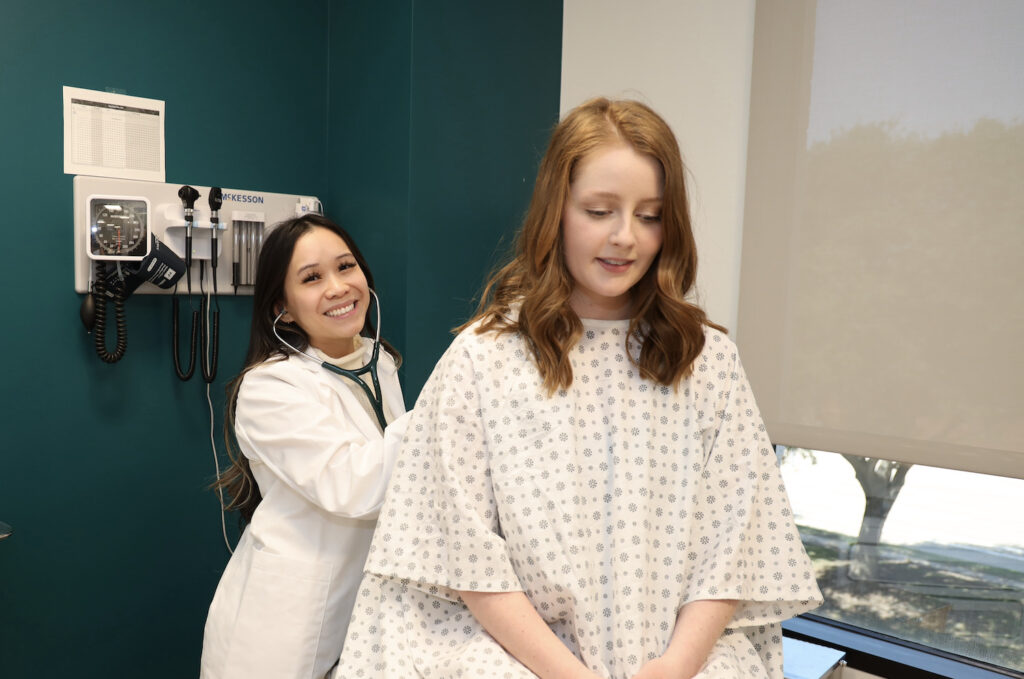
At the WCU Center for Graduate Studies campus, we have 8 outpatient clinical exam rooms and 3-room simulation suite with adult, pediatric, and OB manikins, which mimic the physiological responses of real-life patients. Our MPA California hybrid program students use this space to practice patient history intake, physical exams, and communication skills.
At West Coast University, we are committed to seeing our students and graduates succeed. That’s why we have a Career Services team that is dedicated to helping you find your next career opportunity.
Our career advisors can provide you with the following and more:
These services are available to every WCU student, so you’ll be able to get the help you need even after graduation.
Physician assistants are licensed clinicians who practice medicine in every specialty and setting. They are committed to improving access to care with a focus on patient-centered, team-based medicine.2
As a PA, you will be able to carry tasks that are critical to patients’ health and well-being, including physical exams, diagnosis and treatment of illnesses, prescribing of medications, medical procedures — though these tasks need to be performed in collaboration with a medical doctor. The amount of collaboration that is required varies by state.3
At WCU, a hybrid program is a program that combines both online coursework and in-person learning experiences. Students in our PA program at WCU spend their first year taking online courses and completing on-campus labs for hands-on practice. During the second year, students participate in online coursework and complete their clinical rotations at a local partner sites.
You can complete our physician assistant program in 24 months, which is six trimesters.
While it is helpful to have a bachelor’s degree in the sciences when you apply to our PA program, it is not required. We accept students with all types of bachelor’s degrees.
Our California Master of Physician Assistant program does not allow for transfer credit.
West Coast University’s hybrid Physician Assistant program currently only accepts applicants who reside in the following states: Arizona, California, Florida, Hawaii, South Dakota, Texas, and Vermont. This list is subject to change based on State Authorization regulations. Please contact admissions for any questions by [email protected]
Students are required to enroll from, and maintain physical presence while participating in the program, within the state of residence listed on their enrollment agreement. Students are required to inform WCU prior to moving to any other state. Students are advised that moving to a state where the program is not offered will result in their withdrawal from the program.
Financial aid and scholarships are available for those who qualify. You may be eligible for student aid such as loans, scholarships, grants, federal work-study, employer reimbursement, and military benefits. To learn more, visit our Tuition and Financial Aid page, and be sure to speak with a WCU financial aid advisor to properly explore all your options.
Center for Graduate Studies
590 North Vermont Avenue
Los Angeles, CA 90004
(323) 284-7998
1 WCU provides career guidance and assistance but cannot guarantee employment.
2 American Academy of Physician Associates, “What is a PA?”
3 U.S. Bureau of Labor Statistics, Occupational Outlook Handbook, Physician Assistants, “What They Do,”
Financial aid and scholarships are available for those who qualify.

 Call
Call Info Session