
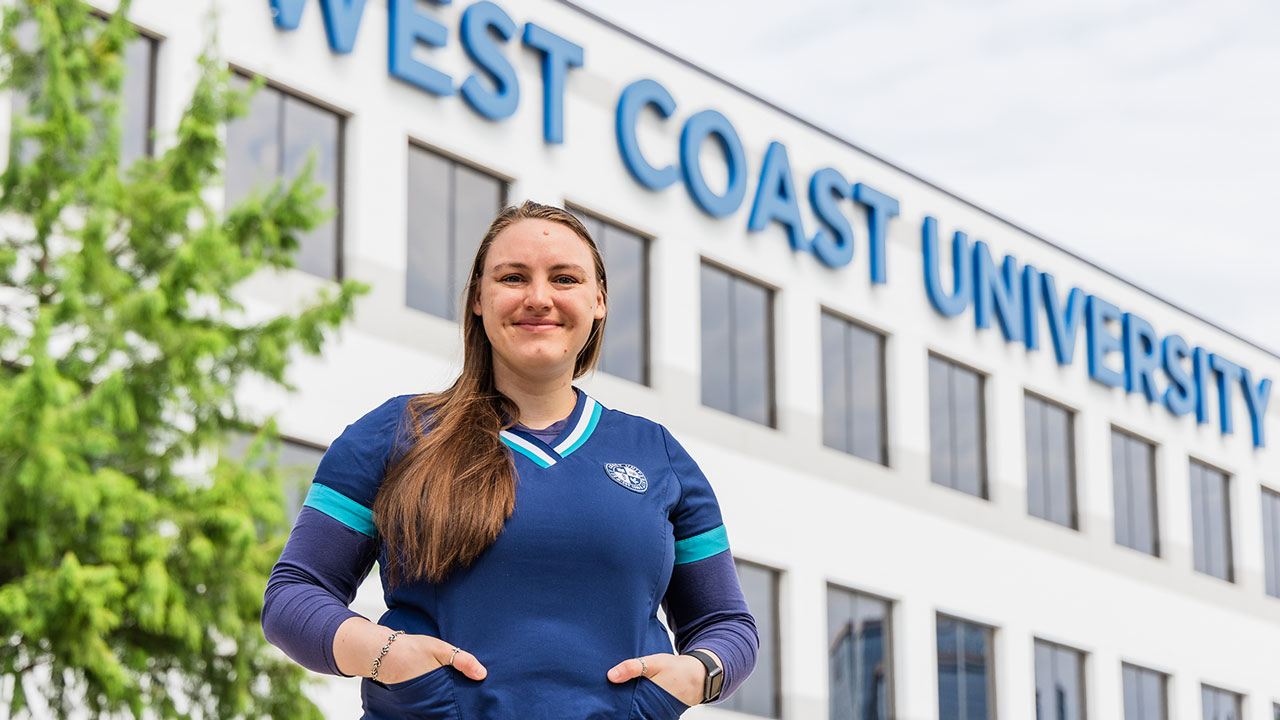
Ready to commit to a Bachelor of Science in Nursing (BSN) program? Whether you’ve always wanted to be a registered nurse (RN) or are changing careers, earning your BSN is the first step toward your goal.
Choosing which BSN to enroll in is a major decision. West Coast University–Texas is proud to offer a BSN program that’s been recognized for excellence: Niche.com ranks WCU–Texas #1 among its Best Colleges for Nursing in America for 2026 and #1 among its Best College for Nursing in Texas for 2026.
In this article, we look at what you can expect if you enroll as a BSN student at WCU–Texas.
What the WCU–Texas BSN Program Is Designed to Do
The WCU–Texas BSN program is an entry-level degree designed to prepare students for initial licensure as an RN. The BSN curriculum consists of 120 credits of coursework that builds in complexity as you move forward in the program. It blends lecture-style classes, hands-on patient care training in our advanced simulation labs, and real-world clinical rotations in a variety of healthcare settings.
After completing the program, you should:
- Understand health science concepts (e.g. pathology, microbiology, human development, etc.) that underpin patient care
- Have a high-level understanding of the U.S. healthcare system, management of healthcare organizations, and nursing leadership and administration
- Have direct clinical experience with a range of patient populations and healthcare settings
- Understand how nurses collaborate with other healthcare professionals to provide patient care
- Be able to provide compassionate, clinically sound care to patients from a variety of backgrounds
- Be prepared to take the National Council Licensure Examination for Registered Nurses® (NCLEX-RN®)
The WCU–Texas BSN is also structured in an accelerated format: you can complete your degree in as few as 39 months, instead of the usual 48-month timeline for a bachelor’s degree elsewhere.
What Are the Admission Requirements, and What Is It Like to Apply?
The WCU–Texas BSN program is open to high school graduates and career-changers alike. No prior college or healthcare experience is required to apply, though we will consider any college credits you may have for transfer.
The essential requirements for admission to the BSN are:
- Proof of high school graduation (or equivalent, such as a GED)
- Proof of one of the following standardized test results:
- SAT: score of 835 or higher
- ACT: 16 or higher
- TEAS: 52 or higher
- Anyone without test results from SAT, ACT or TEAS will need to take the Health Education Systems Incorporated (HESI) exam and achieve a minimum composite score of 76
- WCU–Texas only accepts HESI scores taken within three years of your application date
Before you begin clinical trainings, there are some additional requirements. These include:
- A completed background check, drug screening, and health clearance
- Proof of required immunizations
- Current American Heart Association Basic Life Support (CPR) certification
- Proof of health insurance coverage
What the WCU–Texas Simulation Labs Are Like
Nursing is a hands-on, high-responsibility profession. WCU–Texas gives students a safe space where they can practice patient care skills and learn to collaborate with other professionals: the simulation lab. Our sim labs are accredited by the Society for Simulation in Healthcare (SSH) in the areas of teaching and education.
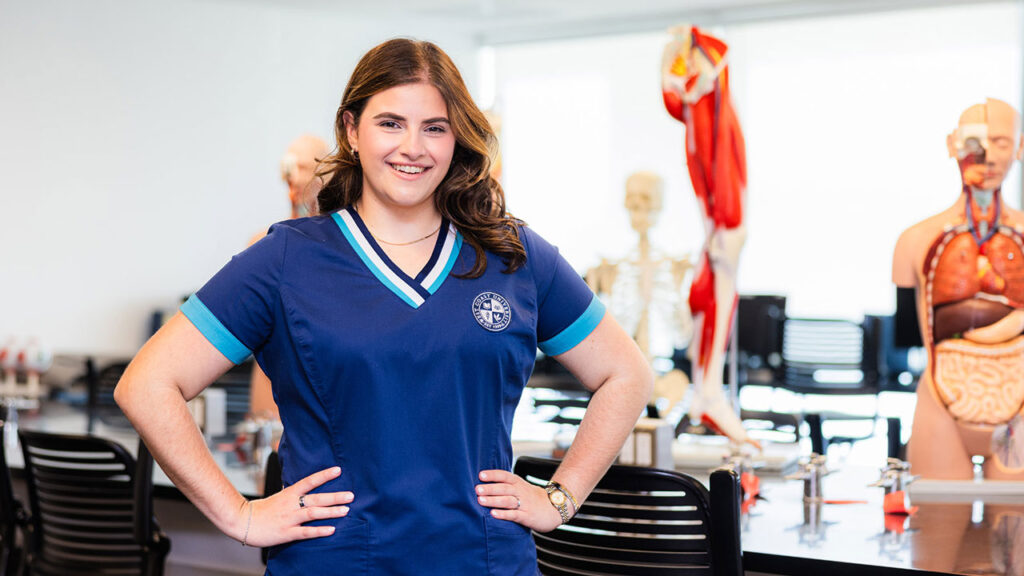
In our labs, you’ll work through different patient encounter scenarios with our high-fidelity manikins. These are specialized healthcare education tools that can mimic many human body functions, from having elevated blood pressure to experiencing seizures and even giving birth.
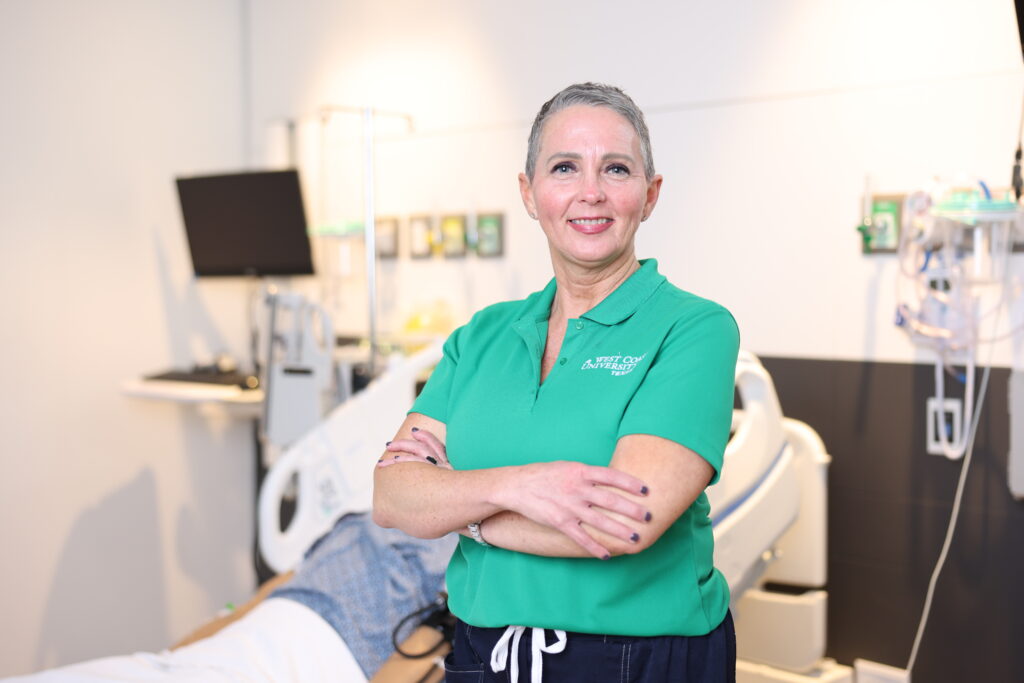
You’ll interact with manikins in realistic hospital settings that use genuine medical equipment like IVs, defibrillators, and medication dispensers. Scenarios cover everything from routine care to emergencies. Instructors monitor your scenarios from nearby observation rooms, providing real-time feedback. Each scenario ends with a debrief that reviews what went well and where you can improve.
You learn more than technical skill in your sim labs. You also:
- Sharpen your clinical and critical reasoning skills
- Gain familiarity with hospital setups and equipment
- Develop your ability to function under pressure
- Learn to communicate with patients and colleagues alike
- Build confidence in your abilities
The goal is for you to leave the sim lab knowing that you’re ready for the next step: clinical rotations.
How Clinical Practicums Work
Clinical practicums take you out of the sim lab and into real healthcare settings across the Dallas metroplex. In your clinicals, you’ll apply what you’ve learned in class and during sim labs to actual, supervised patient care.
Clinical practicums are a bridge between the controlled sim lab environment and the reality of professional nursing. You’ll have the opportunity to work alongside experienced nurses and other care providers while you practice your skills with real patients. You’ll complete multiple clinical practicums at a variety of facilities. The WCU–Texas Clinical Placements team will help you by finding sites, arranging for a preceptor (an experienced nurse to supervise you), streamlining approvals, and helping guide you through how to track your experience.
Preparing for the NCLEX-RN Exam
Once you’ve passed your classes and completed your clinicals, one final milestone remains on your journey to becoming an RN: the NCLEX–RN. Fortunately, as a WCU–Texas student, you’ll have been preparing for the NCLEX from early in your program. We build structured review and preparation into the curriculum.
We also provide plenty of resources in the months leading up to your exam. These include:
- NCLEX advisors
- Study guides
- No-cost tutoring
- Test prep bootcamps
By the time you arrive at your testing center, you’ll have a solid understanding of what topics the NCLEX covers and the types of questions you’ll encounter on the exam.
Career Services: Support for Your Job Search
Support for your success doesn’t stop when you graduate from the WCU–Texas BSN program. As a graduate, you’ll have access to the Career Services team for every step of your job search. Career Services provides support with:
- Career planning
- Locating open positions
- Resume reviews
- Application assistance
- Interview preparation
Whether you’re drawn to hospitals, ambulatory care, nursing and residential care facilities, or a specialized area such as critical care or neonatal nursing, the Career Services team can help you find a role that fits your long-term goals.
Continuing Your Education Beyond the BSN
For many nurses, a BSN is just the beginning. Advancing in the profession requires additional education and training. West Coast University offers several online graduate programs in nursing that can open the door to specialized practice or advanced leadership skills.
WCU’s online Master of Science in Nursing (MSN) program features six different specialization tracks:
- Family Nurse Practitioner (FNP)
- Adult-Gerontology Acute Care Nurse Practitioner (AGACNP)
- Adult-Gerontology Primary Care Nurse Practitioner (AGPCNP)
- Psychiatric-Mental Health Nurse Practitioner (PMHNP)
- Nurse Educator
- Nurse Leader
In the MSN, you’ll benefit from the same personal attention and clinical placement support we provide to BSN students.
WCU also offers online graduate degrees in other areas that may suit your professional goals, including a Master of Health Administration, Master of Business Administration, and a Master of Public Health.
Take the First Step Toward Your BSN
The BSN program at WCU-Texas could be the start of a meaningful career in nursing. To learn more about the program or begin the admissions process, reach out to WCU-Texas’s admissions team or request an information session today.
WCU Distance education programs are delivered out of the California and Texas campuses and may not be available to residents in all states.
Practice Experience is required in order to graduate from the RN to BSN, RN to MSN, MSN, DNP degree and Post-Master’s Certificate Programs.
WCU provides career guidance and assistance but cannot guarantee employment. The views and opinions expressed are those of the individuals and do not necessarily reflect the beliefs or position of the school or of any instructor or student.

 Call
Call Info Session