
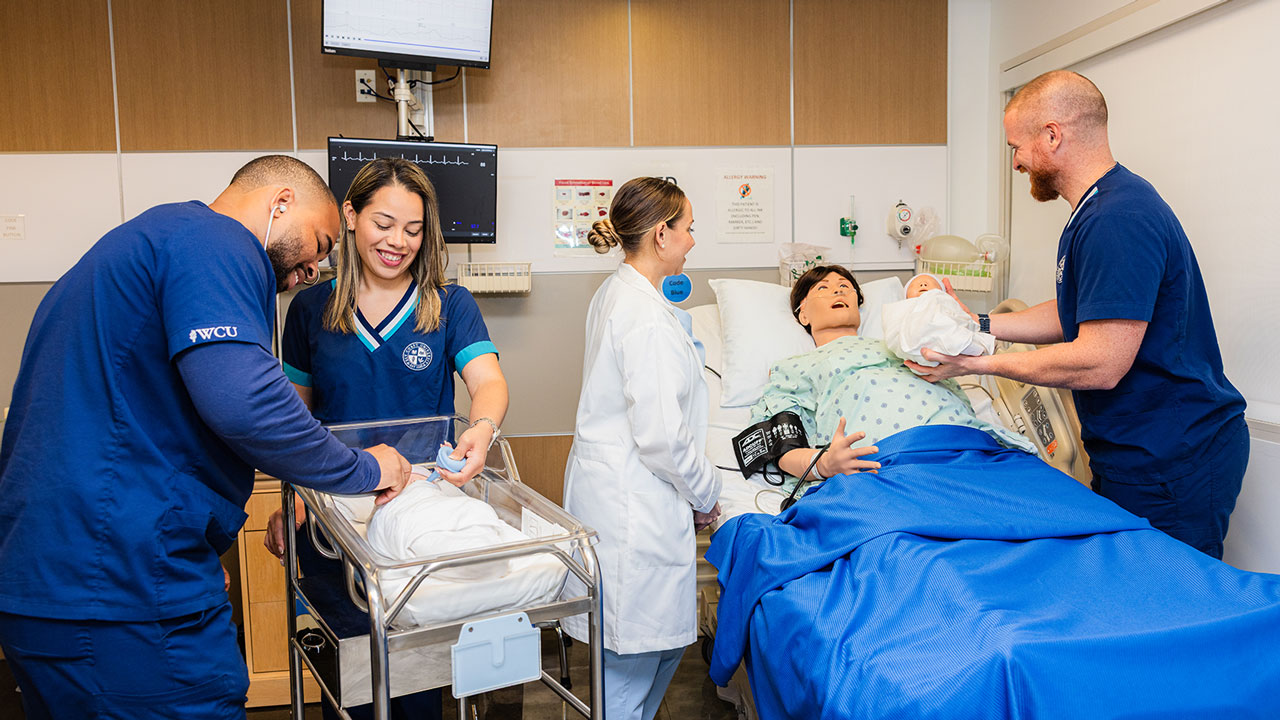
One of your patients is in labor. Another one is experiencing a cluster of symptoms that could be the flu—or maybe the beginning of a dangerous case of sepsis. And a third has just gone into cardiac arrest. While that sounds like an episode of the latest medical drama, it’s not. It’s any given day in West Coast University’s nursing simulation labs.
WCU’s nursing simulation labs are designed to bridge the gap between what you learn in the classroom and what you’ll encounter in real clinical settings. They’re equipped with technologically advanced tools, staffed by experienced instructors, and built around one goal: helping you develop the skills and confidence you’ll rely on throughout your nursing career.
The Technology Behind the Sim Lab
At the center of every simulation are WCU’s high-fidelity manikins—specialized healthcare education tools that are technologically advanced, anatomically correct patient simulators. These aren’t the mannequins you’d find at a clothing store. (WCU uses the term “manikin” deliberately—it’s the healthcare-specific term for these sophisticated simulators.)
These manikins can sneeze, cough, bleed, have seizures, show dilating pupils, exhibit rising blood pressures, and even give birth. They’re designed to respond the way a real patient would, so you can practice assessing symptoms, making decisions, and adjusting your care in real time.
Beyond the manikins, WCU’s simulation labs are set up to replicate actual hospital environments. You’ll find real-life medical equipment—defibrillators, IVs, medication dispensers—arranged the way they’d appear in a working clinical setting. The idea is simple: when you walk into your first clinical rotation, nothing should feel unfamiliar.
What You’ll Actually Do in the Sim Lab
Sim lab sessions at WCU go well beyond basic skills practice. As a nursing student, you’ll work through interactive scenarios that mirror situations you may encounter on the job. That includes learning how to draw blood, administer medications, listen to chest sounds, and respond to sudden changes in a patient’s condition.
WCU’s Clinical Simulation Program defines clearly outlined learning outcomes for each session, including:
- Nursing processes
- Safety
- Infection control
- Therapeutic communication
- Collaboration
- Decision making
- Leadership
Every simulation is intentionally built to prepare you for a specific set of challenges. For example, at WCU-Ontario, simulation faculty collaborated to create a mass casualty simulation that moved beyond the lab and into the campus parking lot. Students responded to a multi-patient emergency scenario in real time, triaging injuries and making rapid clinical decisions.
One BSN student, Alejandra C., described the experience in a 2025 article: “We all walked in thinking it was going to be another regular sim, not that the first group would end up in the parking lot for a mass casualty incident.”
After each simulation, you’ll participate in debrief sessions where you and your instructors review what went right and what could improve. Adjacent to the simulation labs, observation rooms allow instructors to watch your progress and provide real-time feedback—so the learning doesn’t stop when the scenario ends.
Building Confidence Before Your First Clinical
Confidence isn’t something you can learn from a textbook. It comes from repetition, from working through scenarios until the skills feel like second nature. That’s exactly what WCU’s simulation labs are designed to provide.
The simulation labs offer a space to make mistakes and develop your skills in a safe, constructive environment where there’s no real risk to a patient. By the time you begin your clinical rotations, you’ve already responded to emergencies, communicated with “patients,” and practiced critical procedures. You can approach your clinical experience with trust in your skills.
Beyond the Manikin: Learning to Work as a Team
Nursing isn’t a solo profession. From the moment you step onto a hospital floor, you’ll rely on fellow nurses, physicians, pharmacists, physical therapists, and a wide range of other professionals to deliver safe, effective patient care. WCU’s simulation labs are designed to build those collaboration skills before your first clinical rotation.
During sim lab sessions, you’ll work alongside your classmates to assess patients, communicate findings, and coordinate care decisions. When a manikin’s blood pressure spikes or breathing changes mid-scenario, the response has to come from the entire team. You’ll practice delegating tasks, speaking up when something doesn’t look right, and listening to teammates who may catch what you missed.
The debrief sessions after each simulation reinforce this collaborative spirit. You and your classmates review the scenario together, discussing what the team did well and where communication broke down. It’s the kind of honest feedback loop that helps you build trust with your peers and strengthen the teamwork habits you’ll carry into clinical practice.
Accredited for Quality
WCU’s Clinical Simulation Program received accreditation from the Society for Simulation in Healthcare (SSH) in the areas of Teaching/Education. This accreditation recognizes that simulation learning experiences meet established standards of quality and help prepare you for real-life healthcare challenges.
It’s one more way WCU is dedicated to giving you the tools, technology, and hands-on training to help prepare you for your nursing career.
Ready to see WCU’s simulation labs for yourself? Schedule a campus tour to experience the technology, meet the faculty, and find out how hands-on learning can help prepare you for what’s ahead.
Additional Reading
- Technology in Nursing Education: Revolutionizing How Healthcare Professionals Are Trained (WCU Blog)
WCU provides career guidance and assistance but cannot guarantee employment. The views and opinions expressed are those of the individuals and do not necessarily reflect the beliefs or position of the school or of any instructor or student.



 Call
Call Info Session